Who It Helps
Equine Programs for Children with Disabilities: Routines, Activities, and Inclusive Approaches
Behind every calm session is a structure built for predictability. Here's how inclusive equine programs are organized — the routines, activities, and small steps that help children take part.
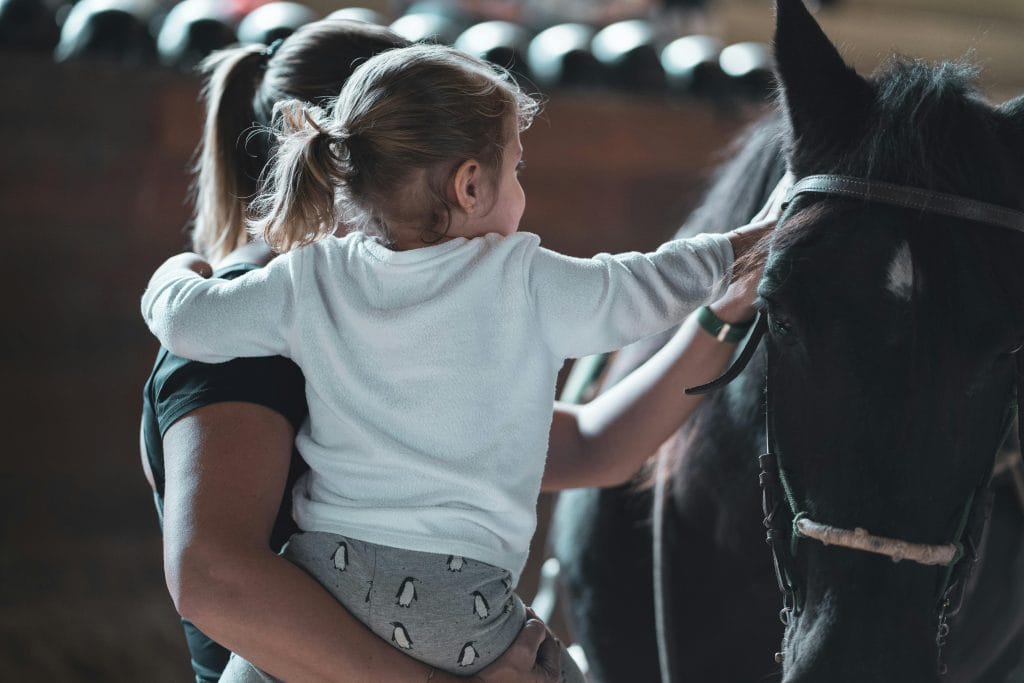
Equine programs for children with disabilities are structured, horse-centered activities — adaptive riding lessons, groundwork, and barn routines — designed so children of varying abilities can take part safely and at their own pace. Rather than a single method, the term covers a range of approaches that share one foundation: predictable routines, accessible activities, and a calm environment built around what each child can do.
Programs vary widely from one barn to the next. Some center on adaptive riding lessons; others lead with groundwork, horsemanship, and barn chores that never require mounting a horse at all. What follows is a look at how these programs are typically organized, the kinds of activities a child might encounter, and the structure that makes the whole experience feel manageable and welcoming.
What Equine-Assisted Programs Include
“Equine-assisted programs” is an umbrella term for several different horse-centered activities that support participation, learning, and engagement. A single center may offer one of these or blend several, and the right mix depends on the child, the staff, and the horses available.
Adaptive Riding
Adaptive riding is instructional riding adjusted to help a child participate safely and comfortably. Depending on the rider’s needs, a lesson might introduce simple steering, transitions between walk and halt, or mounted patterns paced to the child’s comfort. Specialized tack, mounting ramps, and trained side-walkers often make participation possible for children who would not otherwise be able to ride.
Groundwork and Horsemanship
Not every program involves riding. Many children groom a horse, lead it along a designated path, observe its behavior, or help with simple supervised barn tasks. Groundwork offers meaningful hands-on involvement with horses while keeping both feet on the ground, which can be a better starting point for children who are new to horses or more comfortable beginning without mounting.
Group and Community Programs
Some barns run small-group experiences, school visits, seasonal activities, or themed horsemanship sessions. These emphasize inclusion, consistency, and shared routines, giving children a chance to take part alongside peers in a setting built around cooperation rather than competition.
How Structure and Routine Support Participation
Centers that serve children with disabilities often lean on routine to reduce uncertainty, because predictability is one of the things that makes a session feel safe. A child who knows what comes next can put their energy into taking part rather than bracing for surprises.
That predictability shows up in small, repeated patterns: a session might open with greeting a horse and brushing in a familiar order, or reviewing a simple picture schedule of the day’s steps. Activities are usually broken into clear starts and stops, language is kept concise and repeatable so the pattern becomes familiar over time, and mounted lessons tend to use steady pacing, familiar figures, and consistent cues. Together, these elements help a child ease into the environment and understand how each part of the session connects to the next.
Hands-On Involvement, Mounted and on the Ground
Much of the value comes simply from doing. Whether mounted or working from the ground, children interact with horses through purposeful actions — brushing in a set order, leading along a rail or through cones, walking circles and straight lines in a guided lesson, watching how a horse responds to their body language, or completing small barn tasks with staff nearby.
Each step is designed to be easy to follow and to build naturally from the one before it, so a child experiences a steady sense of progress rather than a list of disconnected tasks.
The Barn as a Community
Barns often function as small communities, where instructors, volunteers, families, and children share the same space and rhythms. For many children, that shared rhythm is part of what makes the experience meaningful.
It shows up in predictable greetings, turn-taking during group activities, simple responsibilities like handing over a brush or returning equipment, and closing rituals that mark the end of a session. These small social patterns help a child settle into the life of the barn and recognize their own role within it.
What a Session Looks Like
While every center sets its own format, many sessions follow a familiar arc. A short welcome opens things — a review of the day’s steps and a chance to meet or reconnect with the horse. The main activity follows, mounted or unmounted depending on the program: steering around markers, walking a horse through a pattern, or grooming with guidance. A closing routine wraps things up, whether that means thanking the helpers, brushing the horse one last time, or naming something the child enjoyed that day.
In practice, it can look quietly simple. A child walks beside a small horse, holding the lead rope alongside a volunteer. They pause at each cone in sequence, and with a gentle gesture practiced earlier, the child signals the horse to move on. Walk, pause, gesture, walk — the sequence repeats, giving the session its shape and a clear sense of completion. That steadiness is the point: an arc a child can anticipate is an arc a child can take part in.
How Centers Work With Families
Many programs stay in regular contact with families to keep things clear and comfortable. That might mean sharing the session’s steps ahead of time, offering visual supports, or asking which routines work well at home or school so they can be echoed at the barn. This kind of communication helps build continuity between the barn and a child’s everyday environment, so the experience reinforces rather than competes with the rest of their week.
A Complement, Not a Replacement
Equine programs can be a rewarding part of a child’s week, but they work best alongside — not in place of — the medical, therapeutic, and educational supports a child already has. For a child with a disability, that broader picture might include physical or occupational therapy, speech services, an individualized education plan, or care from a pediatric team.
Families considering a program are wise to talk with their child’s care team about whether it’s a good fit, and to think of the barn as one supportive setting among several rather than a stand-alone intervention. A good program will welcome that conversation and will be clear about what it does and does not offer.
What the Research Suggests
Research on equine-assisted activities for children with disabilities is still developing, and findings vary by approach and by the specific outcomes studied.1 The most consistent evidence sits in narrow, well-defined areas — several reviews have reported improvements in gross motor function and postural control among children with cerebral palsy who take part in therapeutic riding or hippotherapy.2
Evidence for broader claims — around communication, attention, or emotional regulation — is more preliminary, often drawn from small groups studied over short periods. That doesn’t mean these programs lack value; it means families do best to view them as supportive and developmental rather than as a treatment with guaranteed outcomes. The distinction matters most when a program is described in clinical terms: adaptive riding and horsemanship are enrichment and skill-building activities, while hippotherapy delivered by a licensed therapist is a different, clinically directed service.3
Finding the Right Program
Equine-assisted programs for children with disabilities sit alongside a broad range of horse-related activities across the country. Some centers focus exclusively on adaptive riding, others emphasize horsemanship and groundwork, and still others run seasonal camps or small-group experiences. Each barn shapes its offerings around staff training, the horses it keeps, its facilities, and the needs of its community — so it’s worth visiting, asking questions, and watching a session before deciding.
If you’d like to see what’s available near you, you can find a program near you or browse centers by state.
SOURCES
- Professional Association of Therapeutic Horsemanship International (PATH Intl.). Standards and program models for adaptive riding and therapeutic horsemanship. pathintl.org
- Tseng SH, Chen HC, Tam KW. Systematic review and meta-analysis of the effect of equine-assisted activities and therapies on gross motor outcome in children with cerebral palsy. Disability and Rehabilitation, 2013.
- American Hippotherapy Association. Hippotherapy as a treatment strategy delivered by licensed therapists. americanhippotherapyassociation.org