
Benefits of Therapeutic Riding: Strength, Confidence, and Inclusion
Riding a horse asks the body and mind to work together in ways few activities do. Here's what riders actually gain — and where the evidence is strongest.
On this page
- Instruction, Not Clinical Therapy
- Physical Benefits: Moving With the Horse
- Cognitive and Sensory Benefits: Focus, Sequencing, and Regulation
- Emotional and Social Benefits: Confidence and Connection
- Participation, Identity, and Quality of Life
- How Progress Shows Up — On and Off the Horse
- Who Tends to Benefit — and When Riding Isn't the Right Fit
- What the Research Suggests
- A Complement, Not a Replacement
- Finding a Program
Therapeutic riding — often called adaptive riding — is structured, accessible riding instruction for people with disabilities and diverse learning needs. Its appeal is unusual: it's a real sport that asks for genuine skill, yet it's built so riders of nearly any ability can take part. Along the way, riders tend to build strength, balance, focus, confidence, and a sense of belonging that reaches well beyond the arena.
This guide focuses on those benefits — what riders actually gain physically, cognitively, emotionally, and socially, and where the research behind those gains is strongest. For a broader overview of what therapeutic riding is, who it serves, and how to choose a program, see our companion guide on what therapeutic riding is and how it works.
Instruction, Not Clinical Therapy
One distinction shapes everything that follows: therapeutic riding is an educational, skill-building activity, not a clinical service. Riders learn the same foundations as any equestrian — balance, clear cues, reading horse behavior — at a pace that builds competence and independence.
That matters because the benefits below are real but are best understood as the gains of a well-designed learning activity, not as a medical treatment. When a rider needs physical, occupational, speech, or mental-health therapy, those happen separately under licensed clinicians. Many barns collaborate closely with those providers, and the difference between riding instruction and clinical care — including hippotherapy, which a licensed therapist directs — is explained in our comparison of adaptive and therapeutic riding.
Physical Benefits: Moving With the Horse
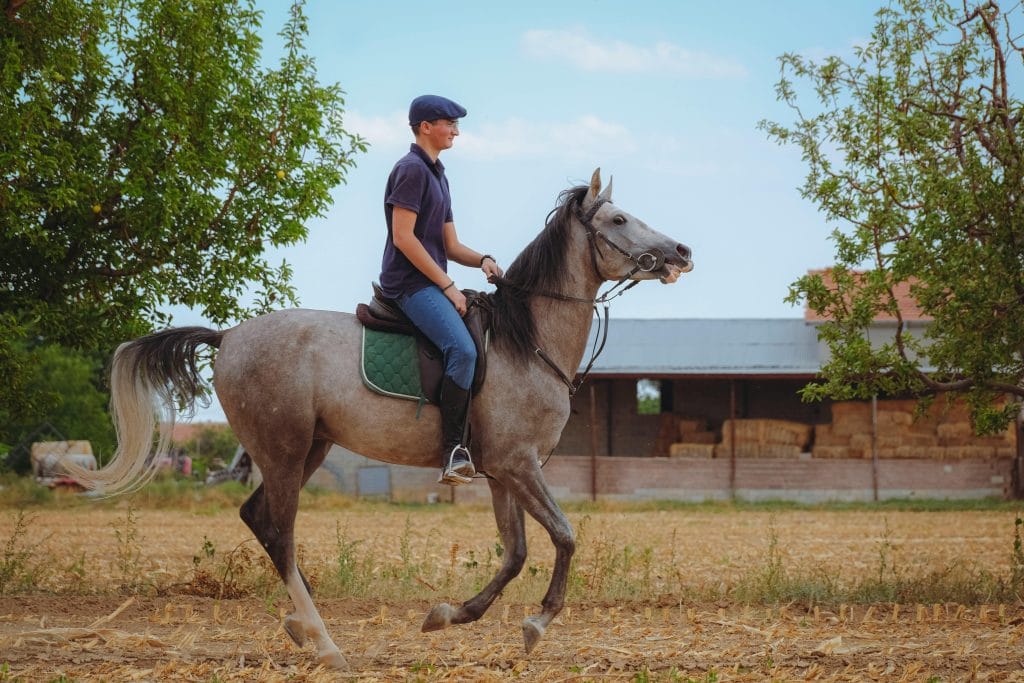
The most distinctive thing a horse offers is the rhythmic, three-dimensional motion of its walk. As the horse moves, the rider's pelvis and trunk respond continuously to stay aligned — a steady, low-impact challenge that, repeated across lessons, helps build functional strength and control.
Over time, many riders develop better core and postural stability, especially through transitions and steering; improved balance and left-right symmetry, as riding patterns encourage awareness of both sides of the body; and stronger motor coordination, as they learn to sequence reins, legs, and visual focus together. These are also the gains with the firmest evidence behind them — several systematic reviews report improvements in balance, postural control, and gross motor function from horseback-riding interventions, with the strongest findings among children with cerebral palsy.1
Families and instructors often notice these changes off the horse, too: a steadier sit at a classroom desk, more confident walking on uneven ground, or more endurance for play and daily tasks.
Cognitive and Sensory Benefits: Focus, Sequencing, and Regulation
Riding invites attention without forcing it. A rider has to track where the horse is going, plan the next turn, and adjust to changing patterns — demands that quietly exercise working memory, sequencing, and adaptability while the rider is simply trying to ride well.
There's a sensory dimension as well. The horse's movement provides predictable vestibular and proprioceptive input, while grooming, tacking, and barn routines offer graded tactile and auditory experiences. Because the activities are purposeful and engaging, the repetition feels natural rather than clinical — which is part of why many riders sustain attention longer in the arena than they might in a more formal setting.
Emotional and Social Benefits: Confidence and Connection
Learning to communicate clearly with a large, responsive animal builds a genuine sense of agency. The wins are small but real and earned — asking for a smooth halt, finishing a pattern, posting at the trot — and that kind of confidence tends to hold up because the rider knows it wasn't handed to them.
The barn community reinforces it. Riders, volunteers, instructors, and families form a setting where effort is recognized, independence is supported, inclusion is the default, and responsibility is shared. Research in this area is younger than the motor-function work, but studies of riders on the autism spectrum have reported gains in social functioning following therapeutic riding, though samples are often small and results vary.2 Many riders also simply thrive on the structure — showing up on time, preparing equipment, greeting the horse, taking part in routines that feel meaningful.
Participation, Identity, and Quality of Life
For many riders, therapeutic riding becomes more than an adapted sport — it becomes a source of belonging and identity. Riders set goals like learning to canter, completing an independent pattern, or taking part in a show, and they celebrate each step toward those milestones. Because success is measured by participation and growth rather than comparison, the arena becomes a rare place to experience plain competence, pride, and joy.
It can look quietly remarkable in the moment. A rider who once needed two sidewalkers begins a simple pattern on their own for the first time. At the final marker they breathe, close their fingers on the reins, and the horse halts square. The grin arrives before the words — a small thing, earned over weeks of steady effort, and a reminder of how skill and confidence grow together.
How Progress Shows Up — On and Off the Horse
Therapeutic riding isn't clinical care, but instructors still track growth, and the markers are concrete: greater independence with mounting, straighter lines and more accurate steering, smoother transitions, less prompting needed, steadier posture and balance during tasks.
Just as telling are the "off-horse" changes families report — better morning routines, more willingness to take on responsibility, clearer communication at home and school. Those carry-over effects are a large part of why riders and families stay with it, even though they're harder to measure than a tidier figure-eight.
Who Tends to Benefit — and When Riding Isn't the Right Fit
Programs commonly serve children, teens, and adults with a wide range of needs — among them autism, Down syndrome, cerebral palsy, learning differences, ADHD, anxiety or low confidence, and coordination or balance challenges. The benefits described above aren't tied to a diagnosis so much as to consistent, well-supported participation.
Riding isn't right for everyone, though, and responsible programs screen for medical and behavioral considerations before a rider mounts — things like spinal stability, hip health, seizure risk, bone fragility, and safety around animals. When mounted work isn't appropriate, many barns offer groundwork, unmounted horsemanship, or carriage driving, which can deliver much of the same engagement and connection without the physical demands of riding. A rider's own care team is the right partner in deciding whether mounted work is a safe fit.
What the Research Suggests
It's worth being clear-eyed about the evidence. The strongest, most consistent findings are physical — balance, postural control, and gross motor function — and they're clearest in children with cerebral palsy.1,3 Evidence for cognitive, emotional, and social benefits is more preliminary: promising, but often drawn from small groups over short periods, with study designs that vary widely.2
None of that diminishes what riders and families experience. It simply means therapeutic riding is best viewed as a supportive, developmental activity with real and sometimes substantial benefits — not as a treatment with guaranteed outcomes. Set expectations there, and the gains it does deliver tend to feel like a welcome bonus rather than a promise riding on the line.
A Complement, Not a Replacement
Therapeutic riding works best alongside — not in place of — the medical, therapeutic, and educational supports a rider already has. For many riders that includes physical or occupational therapy, speech services, an education plan, or ongoing medical care. The barn is one valuable setting among several, and a quality program will say so plainly, welcome contact with a rider's clinicians, and be honest about what riding can and can't do.
Finding a Program
If you'd like to see what therapeutic riding looks like near you, you can find a program near you or browse centers by state. When you visit, the signs of a strong program are easy to read: calm, well-conditioned horses, clean and safe equipment, patient instruction, predictable routines, and staff who can answer clear questions about credentials, adaptations, and how they track progress.
SOURCES
- Stergiou A, Tzoufi M, Ntzani E, et al. Therapeutic effects of horseback riding interventions: a systematic review and meta-analysis. American Journal of Physical Medicine & Rehabilitation, 2017.
- Bass MM, Duchowny CA, Llabre MM. The effect of therapeutic horseback riding on social functioning in children with autism. Journal of Autism and Developmental Disorders, 2009.
- Tseng SH, Chen HC, Tam KW. Systematic review and meta-analysis of the effect of equine-assisted activities and therapies on gross motor outcome in children with cerebral palsy. Disability and Rehabilitation, 2013.
This guide is for general information and isn’t medical or mental-health advice. Talk with a qualified provider about your own situation.