
Equine Therapy for Anxiety: Benefits and What to Know
A barn can be a grounding place to practice calm — but it is not a substitute for treating anxiety. Here is what equine programs offer, what the evidence really says, and how to know if it fits.
On this page
Equine therapy for anxiety uses structured, hands-on time with horses — grooming, leading, groundwork, or riding — as a setting to practice focus, calm, and self-regulation. The barn is predictable and grounding, and because a horse responds in real time to a person's posture and pace, it offers immediate, judgment-free feedback that can make regulating tension feel concrete rather than abstract.
These programs are not a replacement for clinical care and not a treatment for an anxiety disorder on their own; at most they are a supportive complement to it. When the work is led by a licensed mental health professional it is actual therapy; otherwise it is a supportive, non-clinical experience.
This guide is educational only and not medical advice. It covers what the programs involve, what the evidence does and does not show, and how to think about whether one fits — alongside, not instead of, professional support.
What the Evidence Shows
It is worth being clear about the research, because it is easy to overstate. Studies on equine therapy specifically for anxiety are limited and mixed. Several small studies — often delivered as psychotherapy or in the context of trauma and PTSD — suggest equine-assisted approaches may help reduce anxiety symptoms, but systematic reviews consistently note serious methodological weaknesses and conclude that effectiveness has not been firmly established.1, 2
In practical terms, that means an equine program is best understood as a supportive place to practice regulation and build confidence, not a proven treatment for anxiety. Well-established, evidence-based treatments for anxiety exist, so anyone who is struggling should start with a qualified mental health professional, who can advise whether an equine program might complement their care.
Why People Explore It
Beyond the research, people are often drawn to equine therapy because it feels different from a traditional indoor setting.
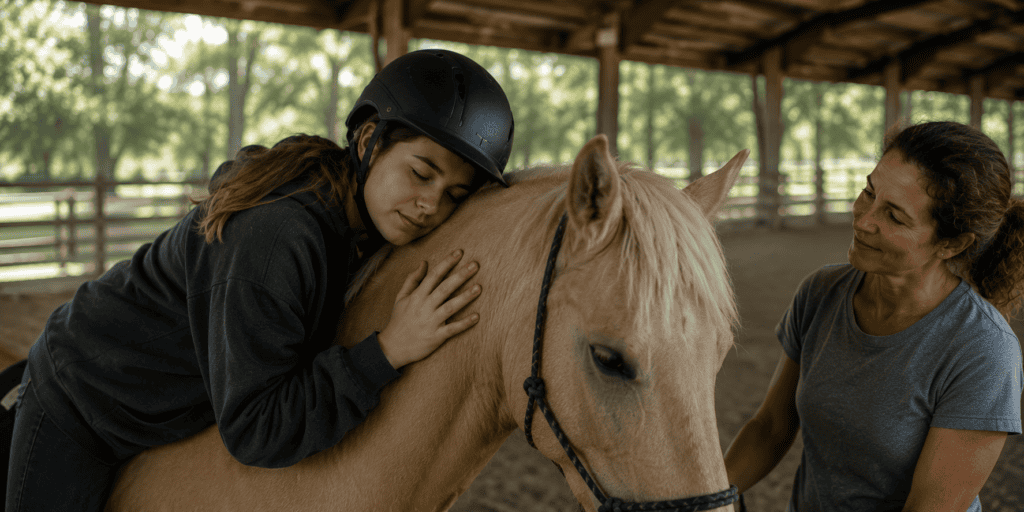
Sessions take place in a barn or outdoor space where movement, routine, and interaction are part of the experience, and for someone with anxiety, that predictability and the clear focus the horse provides can help. The interaction itself is the active ingredient: approach a horse quickly or tensely and it may hesitate or move away; slow down and give clearer, calmer cues and it is more likely to respond.
That visible cause and effect gives people a practical, low-stakes way to notice and adjust their own state, guided by trained staff who adapt activities to comfort and goals.
Program Types
Several kinds of programs exist, and the most important difference is whether a program is clinical — that is, whether it is actual mental health treatment.
| Program | Led by | Clinical? |
|---|---|---|
| Equine-assisted psychotherapy (EAP) | Licensed mental health professional | Yes — actual therapy, often ground-based |
| Equine-assisted learning (EAL) | Trained facilitators | No — educational and skills-focused, often in groups |
| Therapeutic riding | Certified riding instructors | No — recreational, may support confidence |
| Groundwork and unmounted | Instructors or facilitators | No — supportive, lower-pressure |
The distinction matters most for anxiety. Equine-assisted psychotherapy is delivered by a licensed clinician and is integrated with mental health care, while equine-assisted learning, therapeutic riding, and groundwork are supportive activities rather than treatment. Groundwork can be a comfortable starting point for someone who prefers a calmer, lower-pressure setting.
What a Session Looks Like
Most sessions follow a predictable rhythm. A participant usually starts with a brief check-in, then spends time with the horse through grooming or simple tasks to settle and focus, before moving into the main activity — leading exercises, structured challenges, or riding, depending on the program. Facilitators guide the process and help people notice how their actions influence the horse, and the session closes with a short reflection and a consistent routine.
For a fuller walk-through, see what to expect at a session.
Risks, Suitability, and Getting the Right Care
These programs are generally structured with safety in mind, but a few things are worth weighing: the physical realities of working around large animals, the discomfort of being new to horses, outdoor and weather factors, and real variation in program quality and staff experience. A good program is upfront about what it offers and about when a different level of care is more appropriate.
That last point matters for anxiety specifically. For anxiety that is moderate, severe, or interfering with daily life — and certainly for acute distress — the right first step is a mental health professional, not a barn. Equine work, when it fits, is a complement to that care rather than a substitute, and equine-assisted psychotherapy with a licensed clinician is the form most integrated with treatment.
Programs tend to suit people who are drawn to hands-on, outdoor, animal-centered settings and who benefit from structured routine, but suitability is decided individually. When you are comparing programs, our guide to choosing an equine therapy center covers staff qualifications, safety, and the questions to ask.
Final Thoughts
For some people, equine therapy offers a structured, interactive way to practice focus, communication, and regulation in a setting that feels calming and real. It is not a replacement for clinical care, and the evidence for it as an anxiety treatment is still limited — but as a complement to professional support, chosen carefully, it can be a meaningful place to build confidence and awareness over time.
The most important step is finding a program that feels safe and well-structured, and fitting it into a broader plan made with a qualified professional. To explore options, you can browse centers by state.
Anxiety and mental health are sensitive topics. If you or someone you know is struggling, a qualified mental health professional is the best starting point, and in a crisis you can reach a local helpline or emergency services.
SOURCES
- Systematic reviews of equine-assisted interventions for PTSD, anxiety, and mood disorders report mostly positive but methodologically limited findings, concluding that effectiveness is not yet firmly established and that rigorous randomized trials are needed (for example, a 2025 systematic review of equine-assisted interactions on PTSD, anxiety, and mood).
- An earlier systematic review concluded that equine-related treatments for mental disorders lacked strong empirical support (Anestis et al., Journal of Clinical Psychology, 2014), underscoring the need for higher-quality research.
This guide is for general information and isn’t medical or mental-health advice. Talk with a qualified provider about your own situation.