
Equine-Assisted Learning: Life Skills, Communication & Growth Through Horses
Horses cannot be fooled. They respond to how you actually show up, calm or rushed, clear or scattered, which makes them remarkable teachers of the skills that carry into daily life.
On this page
Equine-Assisted Learning (EAL) is an experiential, educational approach in which people build practical life skills by working with horses on the ground. Sessions focus on clear communication, emotional regulation, cooperation, and flexible thinking rather than clinical or therapeutic goals, which sets EAL apart from hippotherapy and other clinical services.
Because horses respond honestly to posture, timing, and intention, they create a learning environment where feedback is immediate, memorable, and often surprisingly meaningful. A participant does not have to be told they rushed or sent mixed signals — the horse shows them, in the moment.
How EAL Works
EAL is built on simple, structured activities. Participants might groom a horse, lead it through a pattern, or work as a team to solve a puzzle in the arena. Each task has a learning target, and every step — from approaching the horse to finishing the activity — is a chance to practice clarity, patience, and effective communication.
The real engine is reflection. After each activity, the facilitator helps participants connect what happened with the skills they are developing. A moment when the horse hesitated becomes a conversation about mixed signals; a smooth partnership becomes an example of teamwork and calm leadership. The insight comes from doing, observing, and adjusting rather than from being lectured.
Why Horses Teach So Effectively
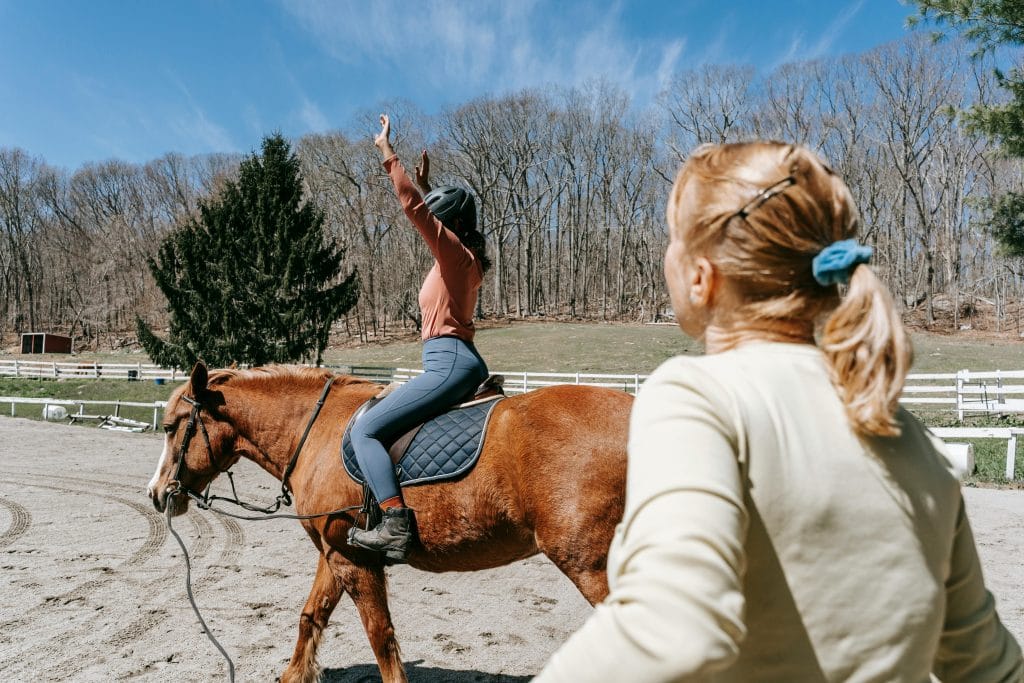
Horses are sensitive, social animals that read intention long before action, responding to even subtle shifts in energy or body language. That responsiveness is what makes them such effective partners in learning. Mixed cues tend to confuse the horse, giving the participant something concrete to adjust, while calm, clear requests are met with cooperation that reinforces good communication. Emotional intensity, such as frustration or anxiety, shows up in the horse's response too, which nudges participants to slow down, breathe, and reset.
The result is a learning loop that is grounded, honest, and relational. Participants feel the difference between forcing and asking, reacting and pausing, rushing and leading with intention.
What an EAL Session Looks Like
Most sessions follow a predictable rhythm that helps participants settle in and know what to expect.
Orientation. Participants meet the horses, learn safety expectations, and set a clear learning focus for the day.
Activity. Tasks unfold at the participant's pace — leading a horse through cones, observing herd behavior, or collaborating on a group challenge — with the facilitator shaping the activity to keep it engaging but manageable.
Reflection. Afterward, participants notice what changed, what worked, and how they adapted, and the facilitator helps link those barn moments to real situations such as group work, school routines, workplace communication, or family dynamics.
What Skills EAL Can Build
EAL tends to strengthen skills that carry across everyday life. On communication, that means matching words with actions, making clear requests, and noticing how others respond. On self-regulation, it is pausing before reacting, adjusting tone or energy, and recognizing when emotions are affecting performance. Problem-solving shows up as planning, adapting, and staying focused when a task gets harder, while leadership and teamwork come through sharing roles, cooperating under pressure, and moving between leading and supporting as needed.
These lessons can land more firmly than classroom equivalents because they are practiced physically, with immediate feedback from an animal that responds to clarity rather than judgment.
A Note on Evidence
It is worth being straightforward here: EAL is experiential education, not clinical treatment, and the formal research base behind it is still developing. Much of what is known comes from program experience and participant feedback rather than large controlled studies. That does not make it worthless — many people find the hands-on, in-the-moment nature of the learning genuinely useful — but it is best approached as a supportive educational experience rather than a proven intervention, and never as a replacement for therapy or medical care.
Who EAL Serves
EAL is a flexible, inclusive option for a wide range of participants: youth developing communication, confidence, or executive function; families working toward collaboration or calmer routines; classrooms and school groups focused on social-emotional learning; workplace teams strengthening leadership and cohesion; and individuals who want structured learning without clinical treatment. It can complement psychotherapy or medical care when someone benefits from experiential practice, but it does not stand in for them.
Safety, Access, and Horse Welfare
Even though EAL is educational, structure and safety remain essential. Programs use clear arena boundaries, consistent routines, and trained horses that are comfortable with public interaction, and facilitators monitor both human and equine stress, adjusting activities as needed. Welfare-first practice matters here: horses work appropriate hours, get rest, and are allowed to communicate discomfort, because a comfortable horse teaches best.
Access is built in as well. Many programs offer quiet barn times, visual schedules, sensory supports, or a gradual entry for participants who need time to observe before joining in.
Measuring Progress
Because EAL is not clinical, progress is tracked through practical skills rather than diagnoses. Facilitators may use simple goal sheets, short rubrics, or group summaries that note behaviors like clearer requests, calmer pacing, or stronger teamwork. Participants often name their own takeaways each week, tying barn lessons back to daily life.
Final Thoughts
Equine-Assisted Learning turns ordinary interactions with horses into transferable skills. Because horses respond to how we show up — our clarity, presence, and intention — each moment becomes a chance to practice communication, leadership, emotional awareness, and adaptability.
Done well, it builds a kind of confidence that feels real: steady breath, clearer boundaries, kinder communication, and teamwork that reaches well beyond the arena. To see what is available, you can browse centers by state in our directory.
This guide is for general information and isn’t medical or mental-health advice. Talk with a qualified provider about your own situation.