
Roles in Equine-Assisted Programs: Who Does What
The calm you see in the arena is the work of a whole team — licensed therapists, instructors, horse handlers, and volunteers. Here is who does what, and why each role matters for a safe session.
On this page
An equine-assisted program runs on teamwork. The calm you see in the arena is the result of several people working together — a licensed therapist or certified instructor leading the session, an equine specialist watching the horse, volunteers walking alongside, and support staff handling intake and safety behind the scenes. Horses bring the movement and connection, but it is people who shape the structure, protect safety, and set the tone for learning.
Knowing who does what helps families choose a program with confidence and helps participants understand who is supporting them and why. This guide walks through each role and how they fit together. If a job title is unfamiliar, the equine therapy glossary defines the terms you will hear at the barn.
The Core Roles at a Glance
Here are the main hands-on roles in a typical session. Smaller programs may combine some of them, while larger centers staff each one separately.
| Role | What they do | In the session |
|---|---|---|
| Licensed therapist | Uses the horse's movement within clinical care, setting and tracking medical goals (hippotherapy) | Leads (clinical) |
| Mental health clinician | Integrates horses into psychotherapy within their licensed scope | Leads (clinical) |
| Riding instructor | Teaches riding and horsemanship, adapted to each rider | Leads (non-clinical) |
| EAL facilitator | Runs structured ground activities for communication and teamwork | Leads (non-clinical) |
| Equine specialist | Selects and monitors horses, reads body language, checks tack fit | Supports |
| Horse leader | Guides the horse from the ground on a steady, predictable path | Supports (often a volunteer) |
| Side walker | Walks beside a mounted rider for stability and to echo instructor cues | Supports (often a volunteer) |
The Participant and Their Circle
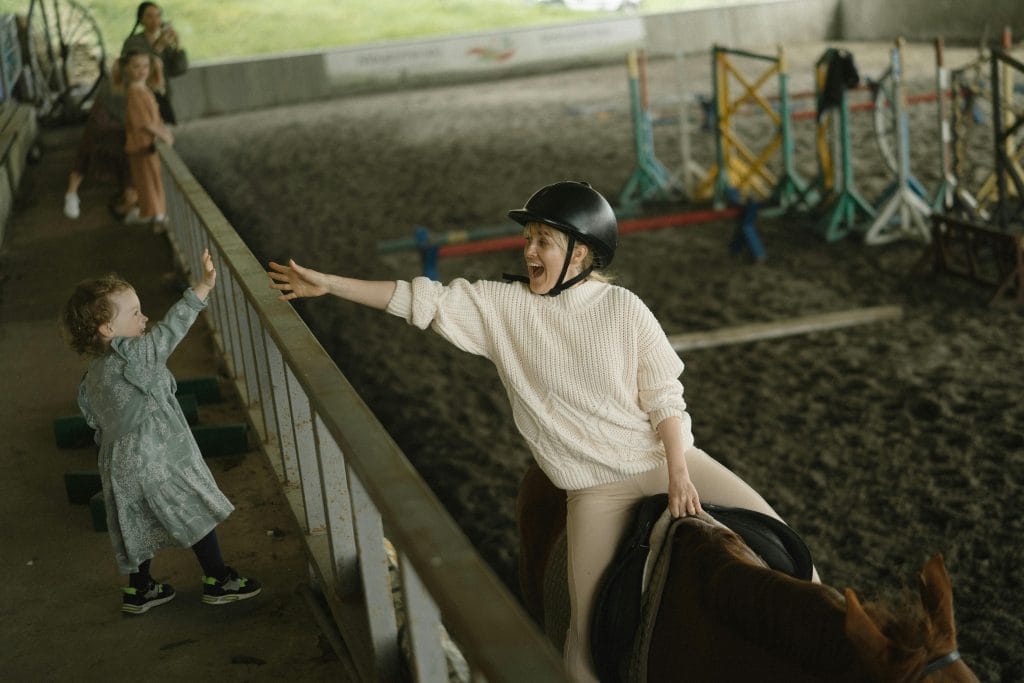
Every session begins with a person and a goal. Children, teens, adults, and older adults take part for many reasons — skill-building, confidence, regulation, communication, recreation, or clinical goals when a licensed therapist is involved.
Caregivers and family members are part of the team too. They often help with preparation, share updates from home or school, and notice changes that might not be obvious in the arena, which helps connect barn skills to everyday life.
Who Leads the Session
Depending on the program type, the person in charge is either a licensed clinician or a certified instructor or facilitator. The distinction matters, because it tells you whether the work is clinical treatment or education and recreation. This guide is informational only; decisions about clinical services should always be made with a licensed provider.
Licensed Therapists in Hippotherapy
When the horse's movement is used as part of clinical care, a licensed physical, occupational, or speech therapist leads. In hippotherapy, the therapist evaluates needs, sets measurable goals, chooses positions and activities, and shapes the horse's movement to support posture, balance, breath, coordination, or communication — with documentation and periodic review so progress is clear to families and care teams.
Mental Health Clinicians in Psychotherapy
Some programs bring horses into psychotherapy, led by licensed mental health providers such as psychologists, clinical social workers, or counselors. They use the horse's behavior and presence to support insight, regulation, boundary-setting, and communication. Much of this work happens on the ground, and the clinician usually partners with an equine specialist who watches the horse's comfort and safety cues.
Therapeutic and Adaptive Riding Instructors
When the focus is riding and participation rather than treatment, certified instructors lead. In therapeutic and adaptive riding, they teach steering, posture, mounting, and transitions while adapting tack, pacing, and teaching style to each rider. Instructors also coordinate volunteers, select suitable horses, and keep the learning environment consistent, encouraging, and safe.
Equine-Assisted Learning Facilitators
Equine-assisted learning builds communication, leadership, problem-solving, and self-awareness through structured, usually ground-based tasks. Facilitators design activities that ask participants to plan, adapt, and collaborate while working safely with horses, then set boundaries, observe patterns, and guide reflection so the lessons carry into everyday life.
The Horse's Support Team
Horses depend on their own specialized team, and that team's work directly shapes safety for everyone else. Equine specialists understand horse behavior, monitor body language, select suitable horses for each activity, and make sure tack fits properly.
Behind them, barn managers and trainers condition horses for their workload, build fitness, and reinforce calm, reliable responses, while veterinarians and farriers handle medical care, dental checks, and hoof health. A comfortable, well-cared-for horse gives clearer, safer responses — which is why welfare is treated as a safety issue, not an afterthought.
Side Walkers and Horse Leaders
Many programs rely on trained volunteers for hands-on support during mounted work. Horse leaders guide the horse from the ground and hold a steady, predictable path, while side walkers walk beside mounted participants to provide stabilization or to repeat an instructor's cue. Good volunteers learn how to stay in the correct position, how to fade their support as a rider gains independence, and how to keep calm, consistent spacing in the arena. If you are curious about helping out, see our guide to volunteering at a riding center.
Behind the Scenes: Intake, Safety, and Leadership
A surprising amount of the work happens before anyone reaches the arena, and it keeps sessions organized and safe.
Intake, Scheduling, and Family Support
Before a first session, intake staff gather background information, any required medical clearances, and the participant's goals. Scheduling teams manage calendars, waitlists, and family communication, and program assistants may follow up afterward, coordinate paperwork, and collect updates that help refine goals over time.
Safety and Risk Management
Strong programs have clear procedures for equipment, spacing, weather, emergencies, and incident follow-up. Designated staff check helmets, tack condition, horse workload, and arena layout, and teams rehearse what to do if a rider loses balance or a horse startles. Predictable routines are what make the whole environment feel steady.
Program Leadership and Quality Standards
Program directors oversee daily operations, staff training, budgets, and long-term planning. Many centers follow standards from organizations such as PATH International or CanTRA for instructor certification and center accreditation, along with guidance from the American Hippotherapy Association for clinical practice. That alignment is part of what keeps programming sustainable and welfare-forward.
How the Roles Work Together
When a program is running well, the roles blend almost invisibly. A participant arrives and checks in; the instructor or clinician outlines the plan; the equine specialist confirms the horse and tack; volunteers move into position. Through the session, everyone communicates quietly and adjusts as needed, and at the end, notes are shared, progress is named, and plans are set for next time.
That teamwork is intentional. It reflects training, respect for the horse, and a shared commitment to helping participants grow in a setting that feels safe, steady, and welcoming. If you are weighing programs, our guide to choosing an equine therapy center covers what these roles look like in practice, and you can browse centers by state in our directory.
This guide is for general information and isn’t medical or mental-health advice. Talk with a qualified provider about your own situation.