
Hippotherapy for Children with Special Needs: What to Know
In the clinic it is balance practice. On a horse, it is a turn taken sitting tall while reaching for a target. For many children with special needs, that shift is what makes the work stick.
On this page
- A Complement, Not a Cure
- What Hippotherapy Is — and Why It Helps
- Who May Benefit
- What the Research Suggests
- Common Goals Addressed in Sessions
- What a Child's Session Looks Like
- Supporting Sensory Regulation
- Recognizing Progress in Daily Life
- Safety, Screening, and Horse Welfare
- Access, Adaptation, and Inclusion
- Working With Families, Schools, and Care Teams
- Choosing a Quality Program
- A Short Vignette
- Conclusion
Hippotherapy is a clinical treatment strategy in which a licensed physical, occupational, or speech-language therapist uses the movement of a walking horse as one tool within a child's plan of care. For many children with special needs, it brings familiar therapy goals — posture, balance, breath, communication — into a setting where practice feels playful and meaningful rather than clinical.
Instead of working on balance or breath in a treatment room, a child experiences those same foundations while sitting on a living partner whose steady movement and honest feedback create natural reasons to organize the body. The therapist shapes the horse's walk for speed, direction, and rhythm to help the child rehearse skills that carry over to home, school, and the community.
A Complement, Not a Cure
It helps to be clear up front about what hippotherapy is and is not. It is not a cure for any condition, and it does not replace the therapies and supports a child's care team has chosen. It works as one part of a broader plan, and whether it belongs in a particular child's plan is a decision made with their licensed providers. With that framing in place, the rest of this guide explains how it works, who it may help, and what the research shows.
What Hippotherapy Is — and Why It Helps
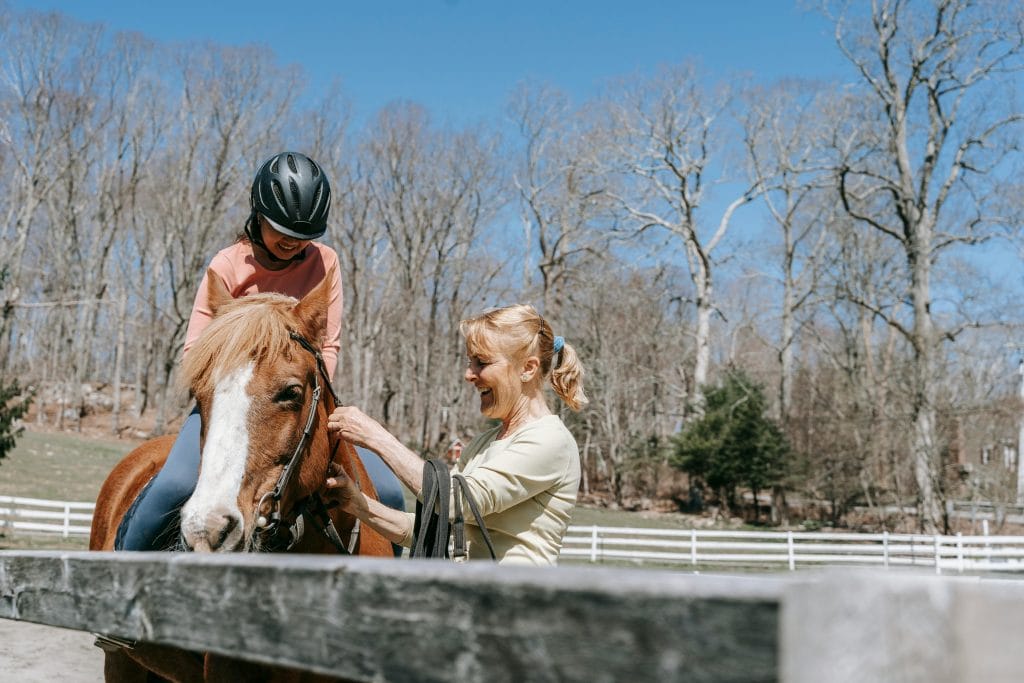
Hippotherapy is not a riding lesson and not recreation. When a horse walks, its pelvis moves in three dimensions that closely resemble human gait. A child seated astride feels that pattern through the trunk and hips, and the body responds by adjusting posture, organizing balance, and coordinating movement.
A key reason it helps is that the horse is a living source of movement. Unlike a mechanical device, its stride can be lengthened, shortened, slowed, or redirected to match the child in the moment. Therapists use those subtle adjustments to influence alignment, engagement, and attention, and a child may ride facing forward, sideways, or briefly in other positions — always with safety supports — depending on which muscles or patterns the therapist wants to draw on.
The aim is never to teach riding; it is to use the horse's motion to create openings for postural activation, symmetry, sensory integration, breath control, or communication, all inside a purposeful, motivating activity.
Who May Benefit
Children with a wide range of abilities may take part when the approach fits their goals and screening shows it is safe. Many programs support children with autism, Down syndrome, developmental coordination disorder, cerebral palsy, sensory processing differences, or motor and speech challenges tied to attention or regulation. Each child's strengths and sensitivities shape how sessions are built, and the decision to include mounted work is always individual.
Some children start with groundwork only, especially if they need time to build comfort, settle into predictable routines, or learn to communicate safely with the horse. Others move into mounted work right away. In every case, the emphasis is on a good match between the child, the horse, and the goals.
What the Research Suggests
Because this guide spans many conditions, it is worth being clear that the evidence behind hippotherapy is stronger for some than for others.
The most rigorous research is in cerebral palsy: a 2020 systematic review and meta-analysis of ten randomized trials, involving 452 children, found favorable effects on gross motor function, while its authors cautioned that the overall evidence base remains limited.1 For Down syndrome, a 2023 randomized controlled trial reported improvements in balance and functional mobility.2
For autism, the picture is more preliminary — small studies and pilots point to possible gains in balance, motor control, and some social or behavioral measures, but reviews note the evidence is limited and call for larger, better-controlled trials.3
For many other conditions the research is thinner still, often small or uncontrolled. The honest summary is that hippotherapy shows promise as a supportive strategy, especially for motor goals, but its effects vary with the child, the condition, the program, and how it is delivered. It is studied as a way to support a child's existing therapy, not to replace it.
Common Goals Addressed in Sessions
Hippotherapy supports the work of PTs, OTs, and SLPs in different but complementary ways, each bringing its own lens while coordinating with the child and family.
Physical therapists often focus on trunk stability, balance reactions, weight shift, and smoother transitions between positions. A child who usually collapses to one side when sitting may find more even alignment as the horse's gait encourages symmetrical engagement, and over time families may notice steadier sitting at a desk, more endurance for play, or greater confidence on stairs and uneven ground.
Occupational therapists weave in functional tasks that build bilateral coordination, grip patterns, sequencing, and visual–motor engagement — reaching across midline, tapping targets, or putting materials in order. The barn becomes a natural place to practice planning, adapting to change, and holding attention while staying regulated.
Speech-language pathologists may pair mounted movement with breathing and voice work. The horse's gentle sway can help a child find a more organized breath pattern, which supports phonation, phrasing, and pacing, and SLPs often add short verbal games, call-and-response, or intentional pauses that link breath with communication.
What a Child's Session Looks Like
Every program has its own character, but sessions tend to follow a predictable rhythm that helps children settle in and know what comes next.
A session usually opens with a brief check-in and a simple preview of the plan, often framed in plain language — "sit tall through the turns," "reach across midline," "use a long breath for three words." Children may help gather brushes or greet the horse, which builds connection and prepares them for what follows.
Mounting is done carefully with a block, ramp, or lift, and sidewalkers or spotters join when a child needs extra stability. Once mounted, the therapist shapes the horse's movement — tempo changes, circles, serpentines, transitions — to help the child practice alignment and coordination, layering in tasks like reaching, scanning for colors or letters, or saying a short phrase with steady breath.
Most sessions close with a cool-down, dismount, and a few minutes of off-horse practice, ending on a simple cue such as "tall, then task" that bridges the barn and daily life.
Supporting Sensory Regulation
Children with special needs often move through sensory environments that feel unpredictable. The barn offers rich sensory input paired with clear structure — visual schedules, consistent sequences, and quiet lesson times that help a child feel grounded.
Grooming provides gentle tactile experience, while mounted work delivers vestibular input through the horse's rhythmic sway, and therapists watch for signs of overload and adjust the environment, activity, or tempo to keep the child comfortable. The purpose is not to erase sensory differences but to help a child find conditions where they can stay engaged, calm, and curious.
Recognizing Progress in Daily Life
Meaningful progress often shows up first outside the arena: a child sitting taller at the dinner table without prompting, carrying a backpack more easily, stepping off a curb with more confidence, or speaking a phrase with steadier breath.
Therapists track change through observation, session notes, simple checklists, occasional video, and feedback from caregivers and teachers — and families play a central role by sharing what they notice and which skills matter most at home.
Safety, Screening, and Horse Welfare
Hippotherapy depends on safe practice for people and horses alike. Sessions are led by licensed PTs, OTs, or SLPs trained in the clinical use of equine movement, with an equine specialist managing the environment, horse selection, tack fit, and safety protocols.
Good programs discuss screening openly. Considerations may include spinal stability, hip health, seizure history, bone fragility, respiratory or cardiac conditions, and allergies. If mounted work is not appropriate, therapists can focus on groundwork or clinic-based strategies that pursue the same goals.
Horse welfare is central, too: suitable horses are chosen for temperament, movement quality, and comfort with the work, and they receive conditioning, rest, and room to communicate through body language — because a comfortable horse provides the clearest, safest therapeutic input.
Access, Adaptation, and Inclusion
Children participate best when the setting supports their needs without removing the challenge. Programs may use visual supports, consistent cues, adaptive pads or surcingles, positioning aids, or shorter sessions with built-in breaks, and some children work in alternative positions on the horse to encourage specific postural responses. Others explore carriage driving or groundwork when riding is not an option.
The goal across every adaptation is the same: independence where it is safe, support where it helps, and dignity throughout.
Working With Families, Schools, and Care Teams
Hippotherapy is most effective when it connects to the child's wider world. When therapists, families, teachers, and other providers choose a shared focus — posture for writing, breath for calm communication, smoother transitions through the day — and repeat a single cue across settings, progress is far more likely to generalize.
Steady communication between the barn and the care team keeps goals aligned and helps gains carry beyond the session.
Choosing a Quality Program
A visit reveals a great deal. Look for calm horses, well-fitted equipment, clear routines, and staff who communicate respectfully. A strong program can explain who leads each session, how goals are set, how safety is maintained, and how horses are cared for and rested — and it welcomes questions and invites collaboration rather than rushing past them.
A Short Vignette
A seven-year-old who tends to slump to one side when seated begins a series of figure-eight patterns on a short-strided, steady horse. With each change of direction, the therapist offers one simple reminder: "grow tall to the inside hand." After several passes, the child's trunk sits more evenly, and stepping down the ramp shows a wider, steadier base. At home that week, the family repeats a single cue — "tall, then task" — during meals and homework.
Conclusion
Hippotherapy turns therapeutic intent into movement a child's body can organize around. For children with special needs, it offers a setting where posture, balance, breath, communication, and regulation can grow through real, motivating experience.
Used by licensed clinicians, with thoughtful adaptations and a horse-centered ethic, the gains made in the arena often travel into classrooms, playgrounds, and family routines — one steady stride at a time, always alongside the rest of a child's care rather than in place of it.
To find a program, you can browse centers by state in our directory.
SOURCES
- Lucena-Antón D. et al. (2020). The Effectiveness of Hippotherapy to Recover Gross Motor Function in Children with Cerebral Palsy: A Systematic Review and Meta-Analysis. (PMC7552760)
- Randomized controlled trial of hippotherapy on balance, functional mobility, and functional independence in children with Down syndrome. European Journal of Pediatrics (2023).
- Srinivasan SM, Cavagnino DT, Bhat AN (2018). Effects of Equine Therapy on Individuals with Autism Spectrum Disorder: A Systematic Review. (PMC6178825)
This guide is for general information and isn’t medical or mental-health advice. Talk with a qualified provider about your own situation.