Equine Programs for Autism: Benefits and Support
For some autistic kids, a barn clicks in a way a clinic never does — movement, routine, and a 1,200-pound partner who reads every cue. Here's what equine therapy can and can't do for autism.
On this page
Equine therapy for autism is an umbrella term for several horse-based services — hippotherapy, therapeutic or adaptive riding, and equine-assisted learning — that some autistic children, teens, and adults use to work on goals like emotional regulation, communication, confidence, and motor and social skills. What they share is a setting built on movement, routine, sensory input, and relationship, which some autistic people find more motivating and less clinical than a traditional therapy room.
Families who explore it are often looking for something that feels different — not necessarily better in every case, but different in a way that can make participation easier and progress feel more natural. This guide covers what the main types of equine therapy involve, what the research does and doesn't show, what a typical session looks like, and how to weigh whether a program is a good fit.
A Complement, Not a Treatment
It is important to be clear about what equine therapy is and is not. It is not a cure for autism, and it is not a standalone treatment that replaces the supports an autistic person and their care team have chosen. Autism is a difference in how a person experiences and interacts with the world, not a disease to be fixed — and the goal of a good program is to support the individual's own goals, like feeling regulated, connecting with others, or building specific skills, rather than making someone "less autistic."
The most useful way to think about it is as one supportive option among many. For some autistic people it adds real value; for others it may not be the right fit. Whether it belongs in a particular person's plan is best decided with the people who know them and their care, including their healthcare or therapy providers.
Types of Equine Therapy for Autism
"Equine therapy" gets used loosely, but it covers a few distinct services with different leaders, structures, and goals. Knowing which is which makes it much easier to compare programs and understand what you are actually signing up for.
| What It Is | Led By | |
|---|---|---|
| Hippotherapy | A clinical treatment strategy that uses the horse's movement as a tool within therapy, toward functional goals like posture, coordination, or communication | Licensed occupational, physical, or speech-language therapists |
| Therapeutic / adaptive riding | Instructional riding lessons adapted for the rider, focused on riding skills, confidence, and overall well-being | Certified riding instructors |
| Equine-assisted learning | Ground-based activities — grooming, leading, handling — built around routine, trust, and interaction without the sensory load of being mounted | Trained facilitators, sometimes with a mental-health professional |
The clinical end of that range (hippotherapy) is delivered by licensed therapists who fold the horse's movement into a plan of care.¹ The instructional and learning ends are less clinical and more about participation, skill-building, and connection. Many barns blend elements of more than one. If you want to compare the two riding-based approaches in detail, see adaptive riding vs. therapeutic riding.
What Programs Tend to Focus On
Programs vary widely, but most organize their work around a mix of physical, emotional, and social goals. On the physical side, that can mean balance, coordination, and motor planning, often through the movement of riding. Emotionally, the rhythm of a horse and the calm of a barn can support regulation and a sense of ease. Socially, because horses respond to body language and tone rather than words, some autistic people find them a low-pressure way to practice communication, attention, and connection.
Strong programs are clear about how they define these goals and how they track progress over time — and they recognize that what helps one person may not help another.
What the Research Says
Research on equine therapy for autism has grown, and it points to some promising effects — but it calls for measured expectations. A focused systematic review found beneficial effects on behavioral skills, and to some extent on social communication, while noting that the evidence for gains in perceptual-motor, cognitive, and broader functional skills is currently limited.² A separate study of a riding intervention reported improvements in the social functioning of autistic children.³
The honest summary is that outcomes vary with the type of program, how it is delivered, and the individual. Equine therapy is best viewed as one supportive option rather than a guaranteed solution, and its value depends heavily on program quality and personal fit.
What a Session Looks Like
Although every center is unique, many inclusive programs follow a steady, repeatable rhythm so participants know what to expect from week to week. That predictability is often the point: clear steps, familiar faces, and simple start-and-finish rituals can lower the uncertainty that makes a new setting hard. Sessions may be mounted or unmounted depending on the program, and instructors tend to adjust pacing, group size, and how they give directions to match each participant's comfort and attention.
Arrival
Sessions often start with a familiar greeting or a short preview of what is ahead — looking at a simple schedule, saying hello to the horse, or naming one focus activity for the day. The aim is to set expectations before anything else begins.
Activity
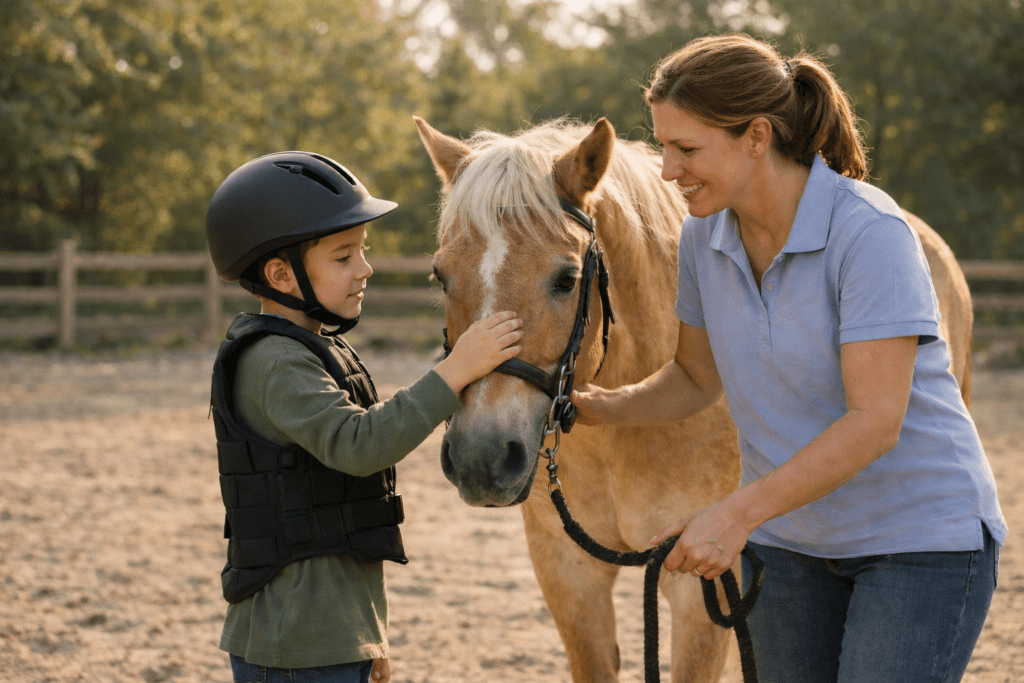
The main portion is built around manageable, repeatable steps. That might mean grooming in a set sequence, leading a horse through a marked path, walking through cones, or riding a basic pattern with guidance. These tasks are chosen because they are easy to understand and let a participant follow a predictable order. Picture a child and a volunteer walking side by side as a pony follows on a loose lead: at each cone the child pauses, glances back, and raises a hand the way they practiced, and the pony stops. The same clear sequence repeats, and the session gains a shape the child can anticipate.
Wrap-Up
Sessions usually close with a short ritual — thanking helpers, brushing the horse one last time, or naming something the participant enjoyed. A consistent ending signals that the session is complete and leaves a concrete sense of having finished a task alongside the horse.
How to Choose a Program
Not every barn is equipped to support autistic participants well, so it helps to look past the surface. Reasonable questions include who leads the sessions and what credentials or training they hold, how the horses are selected and prepared for this work, and how the program supports regulation, handles transitions, and adapts to individual needs.
Fit also depends on the person. Some participants do best in quiet, highly structured settings with minimal waiting; others enjoy group sessions and social interaction. Some benefit most from riding and its movement, while others respond better to ground-based activities that focus on routine and trust without the added sensory input of being mounted.
Knowing how a particular child responds to sensory input makes that choice much easier. Our sister site, Spectrum Parents, has a parent-friendly guide to sensory processing challenges that can help you read those signals before you visit a barn.
A thoughtful program can explain why it recommends a given approach and how it connects to the participant's goals. When you are ready, you can find a program near you in our directory.
Final Thoughts
For some autistic people, the combination of movement, routine, and relationship a barn offers can support regulation, connection, and skill-building in a way that feels natural rather than clinical. For others, it may not be the right setting — and that is fine.
The point is not to find a cure but to find supports that fit the person. If equine therapy sounds like it might help someone you care about, the best next step is a conversation with their care team about whether it complements the rest of their support, followed by a close look at the quality and fit of specific programs.
SOURCES
- American Hippotherapy Association. What Is Hippotherapy? americanhippotherapyassociation.org
- Srinivasan SM, Cavagnino DT, Bhat AN. Effects of Equine Therapy on Individuals with Autism Spectrum Disorder: A Systematic Review. Review Journal of Autism and Developmental Disorders. 2018. ncbi.nlm.nih.gov
- Harris A, Williams JM. The Impact of a Horse Riding Intervention on the Social Functioning of Children with Autism Spectrum Disorder. International Journal of Environmental Research and Public Health. 2017;14(7):776. doi.org/10.3390/ijerph14070776
This guide is for general information and isn’t medical or mental-health advice. Talk with a qualified provider about your own situation.