
Equine Therapy for Children: Benefits and Program Types
Some kids open up around a horse in ways they never do in a clinic or classroom. Here's how equine therapy for children works — and how to find the type that fits yours.
On this page
- Why Families Explore Equine Therapy for Children
- Types of Equine Therapy Programs for Children
- What a Typical Session Looks Like
- Benefits Children May Experience
- What Families and Research Suggest
- Who These Programs Help
- Is Riding Required?
- What Programs Typically Cost
- How to Choose a Program
- Finding a Program Near You
- Frequently Asked Questions
Equine therapy for children is a set of structured, horse-based activities — some mounted, some done entirely on the ground — that can help kids build confidence, coordination, communication, and emotional awareness.
"Equine therapy" is really an umbrella term covering several different approaches, from recreational riding to clinical treatment, so the most useful first step is understanding which type fits a particular child.
Why Families Explore Equine Therapy for Children
Families often look into equine therapy because it offers something different from a clinic, classroom, or living-room setting. The barn brings together movement, routine, fresh air, and the company of a large, responsive animal — a combination many children find engaging rather than overwhelming.
For kids who struggle to stay with structured indoor activities, that change of environment can matter a great deal. The work is physical and hands-on, the feedback from the horse is immediate and honest, and progress tends to show up in small, repeatable moments: a steadier seat, a clearer instruction, a calmer breath. None of this is one-size-fits-all, but a well-run program can give a child a place to participate, build skills, and grow in confidence at their own pace.
It helps to understand a little about how equine-assisted therapy works before choosing a program, because the mechanism — rhythmic movement, clear cause and effect, and a non-judgmental partner — is what the different program types each draw on in their own way.
Types of Equine Therapy Programs for Children
The term "equine therapy" covers several distinct approaches, and they are not interchangeable. Knowing the differences is the single most useful thing a family can do when comparing programs, because it shapes who leads the sessions, what the goals are, and whether the work is recreational or clinical.
Therapeutic Riding
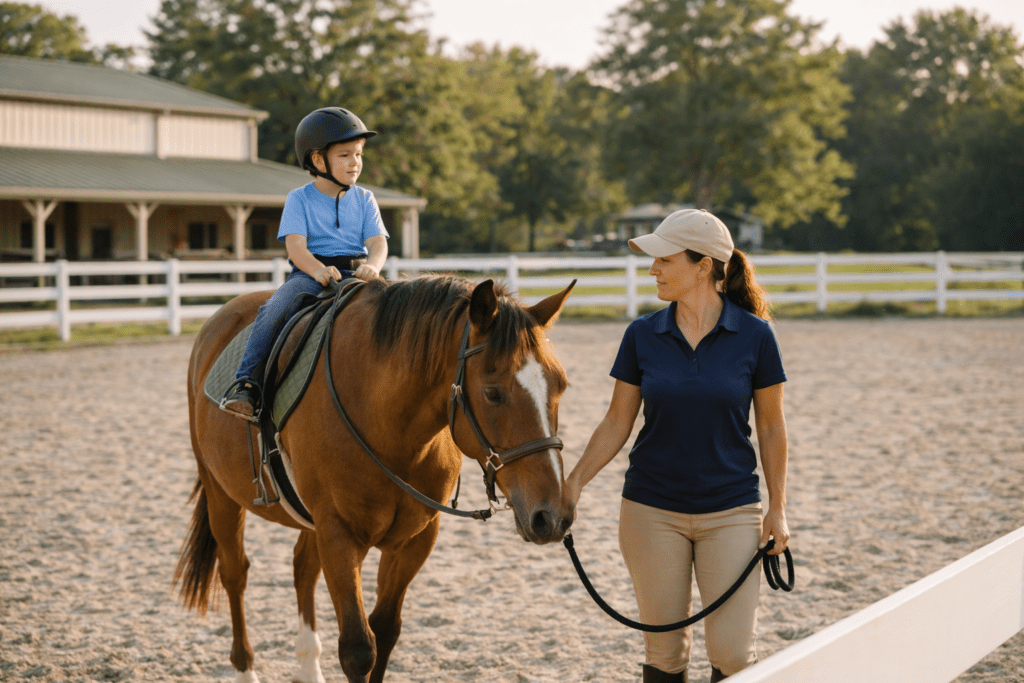
Therapeutic riding is one of the most common starting points for children. It is taught by certified instructors, often trained to standards set by organizations like PATH Intl., in a structured and supportive group or individual setting.
Children learn real riding skills — steering, stopping, simple patterns — alongside games and activities chosen to build balance, coordination, and confidence. It is recreational and skill-building rather than medical, though the benefits children experience can carry well beyond the arena.
Hippotherapy
Hippotherapy is a clinical approach, delivered by a licensed physical therapist, occupational therapist, or speech-language pathologist who has additional training in using horse movement.
Here the horse's gait is a treatment tool, not the lesson itself. The therapist uses the movement to work toward specific functional goals — posture, balance, motor control, or communication — written into a child's care plan. For children with more complex physical or developmental needs, the closely related guide on hippotherapy for children with special needs goes into more depth.
Equine-Assisted Learning
Equine-assisted learning focuses on life skills — communication, problem-solving, emotional awareness, and following through on a task — rather than riding technique. Many of these programs are entirely ground-based.
Activities tend to involve grooming, leading, and working through simple challenges with the horse, which makes this a comfortable fit for children who are cautious about riding or who get more out of hands-on interaction than instruction.
Groundwork and Introductory Programs
Some centers offer beginner or introductory sessions built around basic, unmounted horse interaction. These are a gentle on-ramp for children who are new to horses, nervous about the size of the animal, or simply better served by a slower pace before any riding is introduced.
What a Typical Session Looks Like
Every center runs things a little differently, but most children's sessions follow a recognizable shape, and knowing it ahead of time takes a lot of the unknown out of a first visit.
A session usually opens with the child greeting the horse and helping with simple tasks like grooming or preparing equipment, which gives them a chance to settle in and connect before anything more demanding begins. The main activity follows — this might be riding a short pattern, leading the horse through an obstacle, or a structured game involving steering and stopping — with the instructor guiding each step and adjusting to the child's comfort level. Because horses respond to small shifts in posture and attention, a child quickly sees how their own actions change what the horse does, and that feedback loop becomes part of the learning. Sessions typically close with a calm, predictable routine that helps the child transition out of the activity.
Benefits Children May Experience
Equine programs are not clinical unless a licensed professional is leading them, so it is important to talk about benefits carefully rather than as guarantees. That said, families and program staff commonly report a consistent set of gains over time.
Children may show improved balance and coordination, steadier focus and attention, and more confidence and independence. Many practice communication and following directions in a setting that feels more like play than instruction, and the predictable routine of the barn can be grounding in itself. Emotional awareness often grows simply through reading and responding to the horse. These outcomes are commonly observed rather than promised, and they vary widely from one child to the next.
Equine therapy is best thought of as a complement to a child's existing care and education, not a replacement for it. This article is informational and is not medical advice; a child's doctor or therapist is the right person to weigh in on whether a particular program fits their needs.
What Families and Research Suggest
Interest in equine-assisted activities for children has grown alongside a developing body of research, and it is worth setting expectations honestly about where that evidence stands.
Some studies suggest that horse-based programs may support areas like motor skills, regulation, and social engagement, and many families describe meaningful changes in their child's confidence and comfort. At the same time, the research is still uneven — studies vary in size and quality, and "equine therapy" covers such a range of approaches that findings about one type do not automatically apply to another.
The honest summary is that the early signals are encouraging and the lived reports are positive, while strong, consistent proof is still being built.
Who These Programs Help
Equine programs for children are usually designed to be accessible to a wide range of participants, and most do not require any prior riding experience.
They tend to suit children who enjoy hands-on, physical activity, respond well to structure and routine, are drawn to animals, or simply learn better by doing than by being told. Because programs are adapted to the individual, the better question is rarely whether a child qualifies and more often which type and pace fit them best.
The clearest way to answer that is to talk with programs directly — you can find equine therapy centers near you and ask how they work with new young riders.
Is Riding Required?
Not always — and for many children, it isn't the point. Plenty of programs offer both mounted and unmounted options, and some children get the most out of groundwork that centers on interaction and routine without the added complexity of being in the saddle. A good program will explain exactly what it offers and help you figure out which approach makes sense for your child.
What Programs Typically Cost
Cost varies widely depending on the program type, the provider's credentials, session length, and your location, so it is hard to quote a single figure that holds everywhere.
Clinical hippotherapy delivered by a licensed therapist is generally priced differently from recreational therapeutic riding, and some families offset fees through scholarships, grants, or insurance in specific circumstances.
For a fuller picture of pricing and funding, see our guide on how much equine-assisted therapy costs.
How to Choose a Program
Choosing the right program matters as much as choosing the right activity, and a short visit usually tells you more than any brochure. When you compare centers, it is worth weighing a few things:
- Instructor and therapist qualifications, including relevant certification or licensure
- Safety practices, facility condition, and how horses are cared for
- The temperament of the horses your child would actually work with
- How sessions are structured and how the program supports brand-new participants
Observing a session, or asking to, is one of the best ways to see whether a center's pace and atmosphere are a good match for your child.
Finding a Program Near You
When you're ready to take the next step, the most direct path is to reach out to a few programs and ask your questions in person. Centers vary in what they offer, so a short conversation is the fastest way to find a good fit.
You can browse equine therapy centers by state in our directory and contact the ones that interest you directly.
Frequently Asked Questions
A few questions come up again and again from families exploring equine therapy for the first time. Here are brief, honest answers to the most common ones.
How Old Should a Child Be to Start Equine Therapy?
There is no universal minimum age, since it depends on the program type and the individual child. Many centers set their own age guidelines based on safety and developmental readiness, so the best approach is to ask a specific program what they recommend for your child.
Is Equine Therapy for Children Covered by Insurance?
Sometimes. Clinical hippotherapy delivered by a licensed therapist may be billable in certain circumstances, while recreational programs typically are not. Coverage depends heavily on the provider, the service, and your plan, so it is worth confirming directly with both the program and your insurer.
How Many Sessions Does a Child Need?
There is no set number. Some children attend short-term, goal-focused blocks of sessions, while others take part on an ongoing basis. The right cadence depends on the child's goals and how they respond, and a good program will revisit this with you over time rather than promising a fixed result.
Is It Safe if My Child Has Never Been Around Horses?
Reputable programs are built for exactly this. Sessions for newcomers usually begin slowly, with ground-based interaction and close supervision, and well-trained therapy horses are selected for a calm temperament. Asking a center how they introduce nervous or first-time children is a fair and useful question.
This guide is for general information and isn’t medical or mental-health advice. Talk with a qualified provider about your own situation.