
Equine Therapy Scholarships: Where to Look for Help
The fastest funding help is usually closer than families think: the center itself. Many barns quietly hold donor-funded scholarship money they never advertise. Here is how to find it, and what to ask.
On this page
Equine therapy scholarships are reduced-fee or donor-funded spots offered to help people afford therapeutic riding, hippotherapy, and other programs.
Unlike broader grants, scholarships are usually tied directly to participation at a specific center and handled close to the program level, which often makes them the fastest, most practical form of help — covering part of a session block, a reduced rate over a season, or occasionally the full cost. They are rarely unlimited and often depend on seasonal donations, but they can make participation far more realistic than it first appears.
This guide focuses on where scholarships come from and how to find them. For the wider funding picture, see our guide to grants and funding options; for the difference between the two, see grants versus scholarships.
Start With the Program Itself
The most effective first step is almost always to ask the equine center directly whether it offers scholarships or reduced-fee participation.
Many nonprofit programs and therapeutic riding centers set aside donor-supported funds for this, and plenty have a process in place even when they do not advertise it on their website — some with formal applications, others reviewed informally as funds allow. Centers also tend to know which outside organizations past participants have used successfully, so the conversation is useful beyond their own aid.
When you ask, it helps to find out whether financial aid is currently available, what it is based on (income, diagnosis, veteran status, or another factor), whether it covers full or partial tuition, how long the award lasts, and whether there is a waitlist.
Who Scholarships Serve
Scholarship-style support exists for most participants, though it is not always labeled "scholarship" — subsidized programming, sponsored sessions, and reduced-cost participation all do the same job.
| Who | Where scholarships tend to come from |
|---|---|
| Children and families | Program aid funds, therapeutic riding nonprofits, local disability organizations, parent-led nonprofits, and donor-sponsored youth participation funds |
| Adults | Reduced-fee or donor-supported participation, including recovery and community-wellness programs — often not called a "scholarship" |
| Veterans and military families | Veteran-specific programs (frequently pre-funded), veteran support groups, and donor-backed centers that prioritize this population |
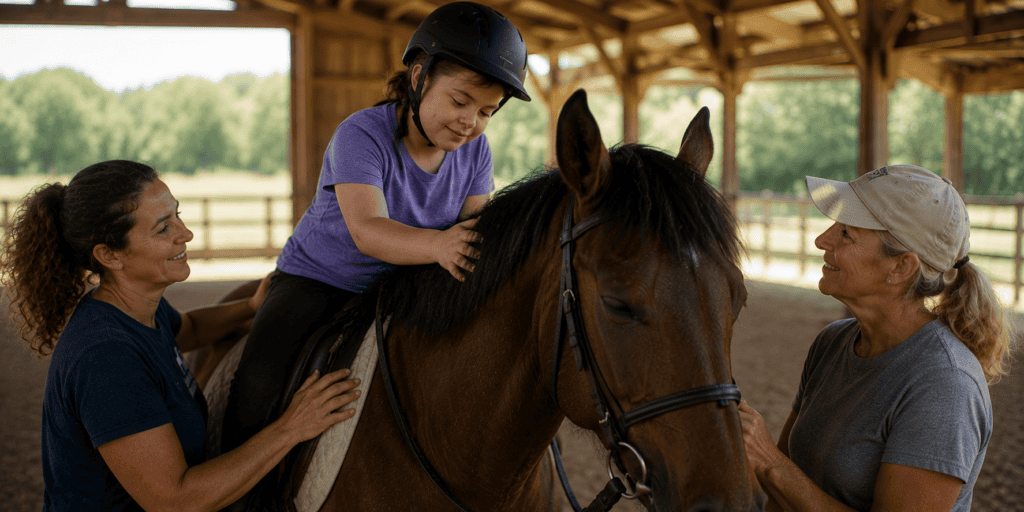
Families with children tend to have the most success when they ask both the equine program and any local organizations already connected to their child's support network. Veteran-focused programs are often funded differently from general participation, so it is always worth asking directly whether veteran-specific support is built in.
Beyond the Center
When the program's own funds are limited, local nonprofit and community groups are often the next best place to look. They may not advertise equine therapy scholarships specifically, but many fund adaptive recreation, disability services, or youth enrichment that can apply to equine participation — and smaller local organizations and nonprofits tend to be more flexible than large national funders, especially when a request is specific and clearly tied to one participant, one season, or one program.
Questions to Ask
A few direct questions, whether to a center or an outside organization, tell you a lot about how realistic the funding path will be:
- Do you offer scholarships or reduced-fee options?
- When are applications reviewed, and is funding seasonal or ongoing?
- Is aid based on income, diagnosis, veteran status, or another factor?
- Does it cover full or partial tuition, and how long does it last?
- Are there donor-sponsored lessons available?
- Is there a waitlist for financial aid?
What to Expect, and Final Thoughts
Scholarship funding is often limited and may cover only part of the total cost — and it is frequently seasonal, applying to one session block or calendar year before requiring renewal. That is all normal.
Many participants end up combining scholarship support with family budgeting, community donations, and reduced-fee options rather than relying on a single source, so the process is most manageable when treated as part of planning rather than a last-minute fix. W
ith persistence, many families and adults find that scholarship help is genuinely available once they know where to look and what to ask — and the equine center is almost always the right place to start. To find programs and ask about aid directly, you can browse centers by state.
This guide is for general information and isn’t medical or mental-health advice. Talk with a qualified provider about your own situation.