
What Is Equine Therapy? Types, Benefits, and How It Works
Equine therapy covers hippotherapy, adaptive riding, equine-assisted mental health, and learning programs. Here's what each involves, who it helps, what research shows, and how to find one.
On this page
Equine therapy is an umbrella term for a range of programs that involve horses to support physical, emotional, cognitive, and social goals. Depending on the program, that can mean a licensed therapist using a horse's movement as a clinical tool, a certified instructor teaching adaptive riding, or a mental health professional bringing horses into counseling.
The terms equine therapy, equine-assisted therapy, and equestrian therapy are used more or less interchangeably in everyday language — but they cover several genuinely different approaches, and knowing which is which is the first step to finding the right program.
This guide explains what equine therapy actually is, the main types and how they differ, how working with horses is thought to help, who these programs are for, what the research does and doesn't show, and how to find a program near you.
The Main Types of Equine Therapy
The single biggest source of confusion is that "equine therapy" isn't one thing. It's a family of approaches with different goals, different providers, and different qualifications. Here are the four you'll encounter most often.
Hippotherapy
Hippotherapy is a treatment strategy used by licensed physical therapists, occupational therapists, and speech-language pathologists. The clinician uses the horse's rhythmic, three-dimensional movement as a therapeutic tool to work toward functional goals — things like postural control, balance, coordination, and motor planning.
It is not a riding lesson, and the person isn't there to learn horsemanship; the horse's movement is the instrument the therapist works with. Learn more in our guide to hippotherapy.
Therapeutic (Adaptive) Riding
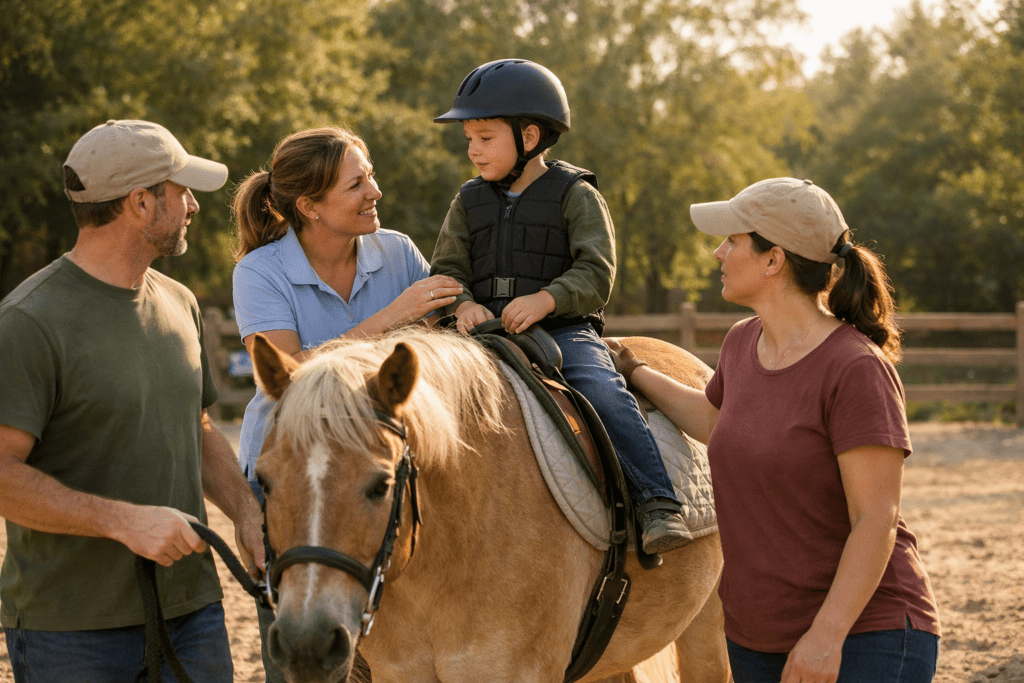
Therapeutic riding — also called adaptive riding — teaches riding skills to people with disabilities, typically led by a specially certified riding instructor rather than a licensed clinical therapist. The goals are recreational and skill-based, and many participants experience meaningful physical, emotional, and social benefits along the way.
The key distinction from hippotherapy is who delivers it and why: an instructor teaching riding, versus a licensed therapist delivering treatment. See therapeutic riding and our side-by-side on hippotherapy vs. therapeutic riding.
Equine-Assisted Psychotherapy and Counseling
Here, a licensed mental health professional incorporates horses into therapy or counseling, often working alongside an equine specialist. Sessions are usually ground-based (not riding) and use interaction with the horse to support emotional and behavioral goals. Several structured models exist for this work.
Equine-Assisted Learning
Equine-assisted learning is educational and developmental rather than clinical — focused on life skills, communication, confidence, leadership, and personal growth. It isn't therapy and isn't delivered as treatment, though it draws on many of the same human-horse dynamics. Read more about equine-assisted learning.
A note on terminology: the professional field increasingly uses equine-assisted services (EAS) as the umbrella term covering all of the above. You'll still see older phrases like "equine-assisted activities and therapies," and the public mostly just says "equine therapy" or "horse therapy." We use the everyday terms here, but point you to the precise category whenever it matters.
How Equine Therapy Works
Why a horse? A few features of working with horses come up again and again in how practitioners describe this work.
The most studied is movement. A horse's walk produces a rhythmic, repetitive, three-dimensional motion that closely resembles the movement of the human pelvis during walking. For someone working on balance, posture, or motor control, that input is difficult to reproduce with equipment — which is the basis for how the horse's gait is used in equine-assisted programs.
Beyond movement, practitioners point to the relationship and feedback a horse provides. Horses are large, responsive animals that react honestly and immediately to a person's behavior and emotional state, which can make them powerful partners for building trust, self-awareness, and regulation.
The environment matters, too: being outdoors, around animals, in a non-clinical setting can lower anxiety and increase engagement compared with a typical office or clinic. Our guide to how equine-assisted therapy works goes deeper on the mechanisms.
Who Equine Therapy Is For
Equine therapy programs serve children, teens, and adults, and people explore them for a wide range of reasons — physical and developmental differences, sensory and motor goals, emotional and behavioral health, recovery, and personal growth. Which approach fits depends entirely on the goal: a motor or developmental goal points toward hippotherapy delivered by a licensed therapist, an emotional or behavioral goal toward equine-assisted counseling with a mental health professional, and a recreational or skill-building goal toward adaptive riding.
Because the right fit is so program-specific, the most useful first step is usually to talk with providers about your goals and ask what they offer. Our directory lets you find programs near you and see what each one specializes in.
What the Research Says
It's worth being straight about the evidence, because it varies a lot by approach and by goal.
Research into equine-assisted programs is growing, but it is uneven. Some applications have a stronger base than others — for example, the use of equine movement for motor outcomes such as postural control and gross motor function has been examined in a number of studies, particularly in children with certain physical conditions. Applications in mental health and emotional wellbeing are promising and widely reported by participants, but the formal evidence is less established, and researchers consistently note the need for larger, more rigorous trials.
The responsible way to think about it: equine therapy is generally described by providers as a complement to conventional care, not a replacement for it. If you're considering it for a specific medical or mental health condition, the right move is to discuss it with a qualified healthcare provider who knows your situation. This guide is informational and isn't medical advice.
What a Typical Session Looks Like
Sessions vary by program type, but most share a rhythm: a greeting and grooming or connection phase, the core activity (mounted work in riding-based programs, or ground-based interaction in many mental health and learning programs), and a wind-down.
A first visit usually includes an intake conversation about goals, any relevant health information, and an assessment of fit. You generally don't need any prior horse experience. Here's what to expect at a first session.
Who Provides Equine Therapy
This is where qualifications matter, and where the type of program determines who's leading it. Hippotherapy is delivered by licensed PT, OT, or SLP professionals. Equine-assisted counseling is led by licensed mental health professionals. Adaptive riding is taught by certified therapeutic riding instructors.
Several organizations set standards and credentials in this field — including PATH Intl. (the Professional Association of Therapeutic Horsemanship International), the American Hippotherapy Association, and EAGALA for mental health work. Accreditation and certification are a useful signal when you're evaluating a program. You can learn more about PATH International, about equine therapy certification and the organizations behind it, and about how to choose an equine therapy center.
How Much Does Equine Therapy Cost?
Cost depends on the program type, length, location, and whether you're paying privately or through a clinical setting. Some clinical services delivered by licensed therapists may be billable to insurance under certain conditions, while recreational and learning programs typically are not — though many nonprofits offer grants, scholarships, and sliding-scale fees. See our guides to equine therapy costs and insurance and funding options for the details.
How to Find an Equine Therapy Program
The best program for you depends on your goal and who's delivering the service — so the most useful thing you can do is compare real options near you and ask the right questions. Our directory lists programs across the United States and Canada.
Find an equine therapy program near you →
Frequently Asked Questions
A few of the questions people most often ask when they first look into equine therapy — and short, straight answers to each.
Is Equine Therapy the Same as Horseback Riding?
No. Some programs (like adaptive riding) involve riding, but many — including hippotherapy and most equine-assisted counseling — are about how a licensed professional uses the horse's movement or presence toward a goal. Plenty of equine therapy happens entirely on the ground.
What's the Difference Between Equine Therapy and Equestrian Therapy?
They're generally used to mean the same thing. "Equestrian therapy," "equine therapy," "equine-assisted therapy," and "horse therapy" are all everyday names for programs that involve horses for therapeutic, learning, or developmental purposes. What actually differs is the type of program — see the four types above.
Do I Need Any Horse Experience?
Usually not. Programs are designed to welcome people with no prior experience, and staff handle the horsemanship so you can focus on your goals.
Is Equine Therapy Covered by Insurance?
Sometimes, depending on the service, the provider's credentials, and your plan — clinical services from licensed therapists are more likely to be billable than recreational programs. Our insurance and funding guide covers what to ask.
Which Type of Equine Therapy Is Right for Me?
Start from the goal. Motor or developmental goals point toward hippotherapy; emotional or behavioral goals toward equine-assisted counseling; skill-building and recreation toward adaptive riding. When in doubt, talk to a few programs near you and ask how they'd approach your goals.
This guide is for general information and isn’t medical or mental-health advice. Talk with a qualified provider about your own situation.