
What Is EAGALA? The Ground-Based Equine Therapy Model
No saddle, no riding, no lead from the therapist. EAGALA built one of the field's most distinctive models on a simple idea: put a person and a loose horse in an arena, and let the horse tell the truth.
On this page
EAGALA — the Equine Assisted Growth and Learning Association — is an international nonprofit that trains and certifies professionals in its own distinctive approach to working with horses for mental health and personal development.
Founded in 1999, it has grown into one of the largest professional bodies in the field, with roughly 4,500 members and several hundred programs across some 50 countries. What sets it apart is the model itself: every session is ground-based, with no riding, and is run by a two-person team rather than a single instructor or therapist.
This guide explains what the EAGALA Model is, what it is used for, how its certification works, and how it fits alongside the other major organizations in equine-assisted services.
The EAGALA Model
The heart of EAGALA is a specific, structured way of working that looks quite different from riding-based programs. Three features define it.
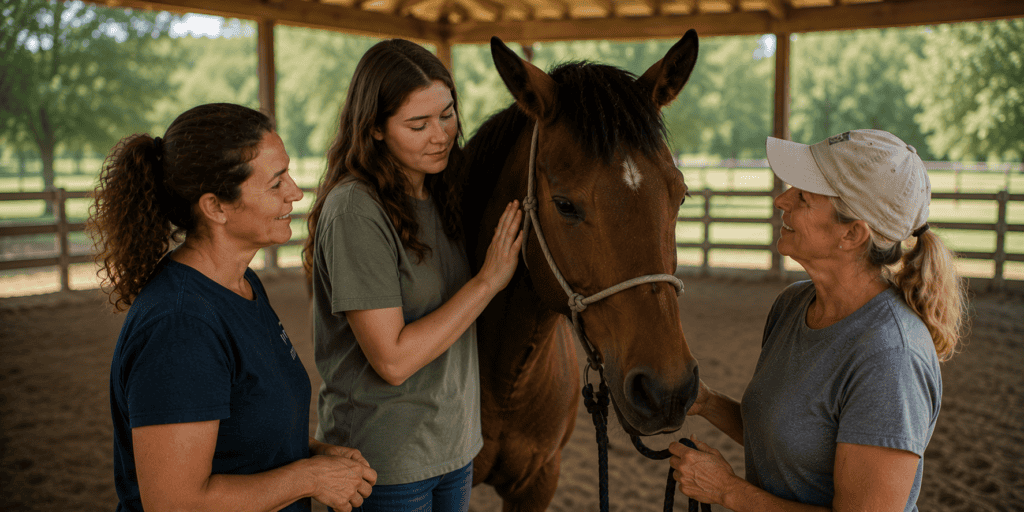
First, it is ground-based. Clients do not ride; instead, horses are loose and free to move and respond naturally in an arena or pasture. That freedom is the point — an unrestrained horse offers honest, unscripted reactions, and keeping everyone on the ground lets clients and facilitators stay fully engaged in observing and interacting.
Second, it uses a co-facilitating team. Every session brings together a licensed mental health professional, a qualified equine specialist, and one or more horses, all working as partners in real time. The mental health professional holds the therapeutic frame while the equine specialist reads and speaks to the horses' behavior, and the two perspectives together shape the experience.
Third, it is client-led. The model works from the assumption that clients hold the best answers for themselves, so the team holds space and avoids imposing interpretations. Clients engage with the horses through experiential, ground-based activities, and the patterns and metaphors that emerge become the material for insight and growth.
What the Model Is Used For
EAGALA's framework covers two related applications: equine-assisted learning (EAL) and equine-assisted psychotherapy, the clinical form delivered by a licensed mental health professional.
In a mental health context, the model is used with concerns such as trauma and PTSD, addiction, depression, anxiety, and behavioral challenges. In its learning applications, the same team approach is used for organizational team-building, youth programs, and personal development.
It is worth being measured about evidence. Research on equine-assisted psychotherapy is still developing — early studies are promising, particularly around trauma, but the overall evidence base remains limited and many studies are small. EAGALA-model work is best understood as a complement to mental health care rather than a replacement for it, and anyone seeking help for a clinical concern should work with a qualified professional.
Certification and Training
Unusually, EAGALA certifies both halves of its team — licensed mental health professionals and qualified equine specialists alike.
Candidates complete a standardized fundamentals training that teaches the model's skills and thinking, followed by assessment and then certification, after which a practitioner can facilitate sessions alongside their mental health or equine specialist partner.
Certification is maintained through continuing education, and the organization also offers advanced certification and specialty designations for practitioners who want to deepen their expertise. A shared code of ethics serves as the model's global standard, with the wellbeing and safety of both clients and horses built into how members are expected to practice.
How EAGALA Fits Among Other Organizations
Families often encounter several organizations in this field, and they occupy different niches. The clearest way to place EAGALA is alongside the other two most recognized bodies.
| Organization | Primary focus | Approach |
|---|---|---|
| EAGALA | Mental health and learning (psychotherapy and EAL) | Ground-based and team-facilitated, with no riding |
| PATH International | Adaptive and therapeutic riding, center accreditation | Mounted and ground work, riding-instruction focused |
| American Hippotherapy Association | Hippotherapy (clinical PT, OT, SLP) | Equine movement used within licensed therapy |
In short, where PATH International centers on riding and instruction and the American Hippotherapy Association focuses on equine movement in clinical therapy, EAGALA occupies the mental-health-and-learning space, defined by its ground-based, team-based method. The three are complementary rather than competing, and a single center may work within more than one framework.
Finding an EAGALA Program and What to Expect
EAGALA maintains a directory of certified members and programs on its own website, which is the most direct way to find practitioners trained in the model. In a session, expect to stay on the ground — there is no riding — and to work with a two-person team and one or more loose horses on activities that surface patterns worth exploring, rather than receiving instruction or interpretation.
If the approach appeals to you, it is worth confirming that a program's practitioners are EAGALA certified and, for psychotherapy specifically, that the mental health professional is licensed. You can also browse centers by state in our directory and ask which model or models a program follows.
Final Thoughts
EAGALA represents one of the more distinctive corners of equine-assisted services: a structured, ethics-driven, ground-based model that pairs mental health and horse expertise on equal footing and trusts clients to find their own answers.
It is not the only way to work with horses for growth and healing, but its team approach and no-riding philosophy give it a clear identity in a varied field — and for people drawn to an experiential, conversation-light setting, it can be a meaningful option to explore alongside professional care.
This guide is for general information and isn’t medical or mental-health advice. Talk with a qualified provider about your own situation.