
Equine Therapy for PTSD: What It Is and How It May Help
Of the mental-health uses, PTSD has the most research behind equine work — and the clearest message that it belongs alongside trauma care, not instead of it. Here is what the programs offer.
On this page
Equine therapy for PTSD covers several kinds of horse-based programs, and the differences matter. Some involve licensed mental health professionals incorporating horses into trauma treatment; others are educational or participation-based, focused on structured activity, communication, and routine.
When the work is led by a licensed clinician it is actual therapy; otherwise it is a supportive, non-clinical experience. None of these programs replaces trauma-informed care — especially when symptoms are severe — but many people are drawn to them because a barn can feel calmer, more grounded, and easier to engage with than a traditional setting alone.
This guide is educational only and not medical advice. It explains the program types, what the evidence does and does not show, and how to think about fit — alongside, not instead of, professional support.
What the Evidence Shows
Among mental health uses, PTSD has some of the more developed research behind equine programs, though it is still early. Several studies — and a meta-analysis using a standard PTSD measure — have found that equine-assisted approaches may reduce PTSD symptoms, particularly as an adjunct to other care and in veteran populations.1 At the same time, systematic reviews caution that many of these studies are small or methodologically limited, so effectiveness is not yet firmly established.2
The practical takeaway: equine work is best understood as a complement to trauma-informed treatment, not a replacement for it. Well-established, evidence-based therapies for PTSD exist, and a trauma-informed professional is the right place to start — and to advise whether an equine program might fit alongside that care.
Why People Explore It
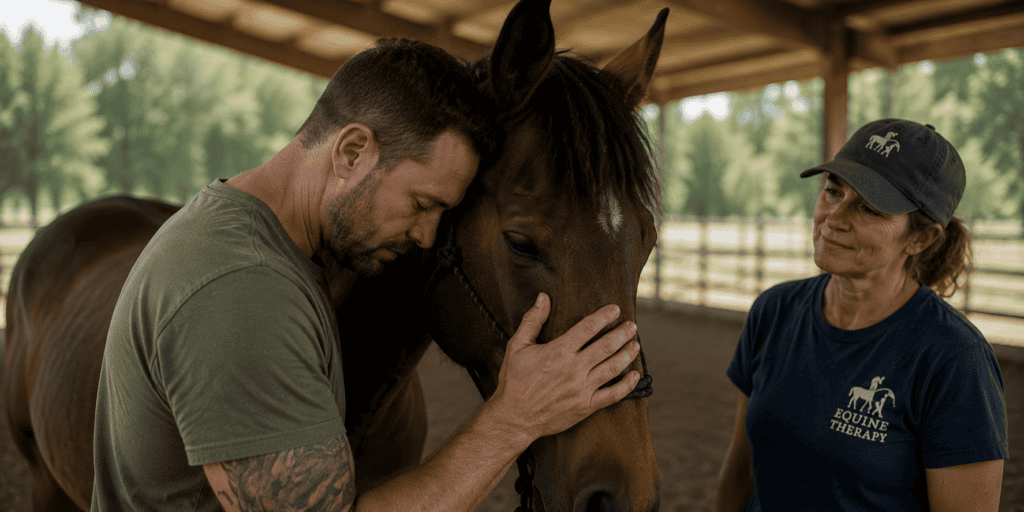
Beyond the research, people are often drawn to equine programs because the environment feels different from traditional support. The barn has its own rhythm — movement, routine, physical space, and a clear task to focus on — and instead of sitting across from someone in an office, participants are brushing, leading, or working alongside a horse in real time. The horse itself is part of the appeal: it does not respond to someone's history, diagnosis, or explanation, only to what is happening in the moment.
That immediacy is the active ingredient. Approach a horse with tension, rush a cue, or try to force movement, and it may stop, hesitate, or shift away; slow down, adjust posture, and become clearer and more consistent, and it often responds differently. That feedback is visible and immediate, which can make the experience feel practical rather than abstract. Combined with predictable routines and outdoor, hands-on activity, it helps explain why participation can feel more manageable for people who find conventional settings draining or emotionally loaded.
Program Types
Programs vary widely, and the key difference is whether a program is clinical — that is, whether it is actual mental health treatment.
| Program | Led by | Clinical? |
|---|---|---|
| Equine-assisted psychotherapy (EAP) | Licensed mental health professional | Yes — part of mental health treatment, usually ground-based |
| Equine-assisted learning (EAL) | Trained facilitators | No — educational, skills-focused, individual or group |
| Therapeutic riding | Certified riding instructors | No — recreational and structured |
| Groundwork and unmounted | Instructors or facilitators | No — a lower-pressure starting point |
For PTSD, the distinction is important. Equine-assisted psychotherapy is delivered by a licensed clinician and is part of mental health care, while equine-assisted learning, therapeutic riding, and groundwork are supportive activities rather than treatment. Groundwork, with no riding involved, is often a comfortable entry point.
Benefits People Describe
Because these programs are not always clinical, it is important not to overstate what they do — but participants often describe certain benefits that emerge through regular, structured involvement. Some notice a stronger awareness of their body language, breathing, and tension, or find they can pause before reacting, especially when the horse's response makes their own pacing obvious.
Confidence tends to grow through repeated success in small, manageable tasks — leading a horse calmly, finishing a grooming routine, completing a session that once felt intimidating. And routine itself is a recurring theme: barn work has a clear beginning, process, and close, and that predictability is part of what can make the experience feel safe enough to return to. As always, these vary by person and program.
What a Session Looks Like
Most programs follow a predictable format, which can be steadying in itself. A session usually opens with a short check-in and time spent with the horse — grooming, observing, or preparing — to establish focus, then moves into the main activity: leading exercises, structured challenges, group work, or riding, depending on the program. A facilitator or clinician helps the participant stay engaged and notice what is happening in the interaction, and the session ends with a closing routine, which in clinical settings may include guided reflection. For a fuller walk-through, see what to expect at a session.
Risks, Suitability, and Getting the Right Care
These programs are generally designed with safety in mind, but they involve large animals, outdoor settings, and a degree of unpredictability worth taking seriously — and emotional fit matters as much as physical safety. Some people feel uneasy around horses, and weather, noise, smells, and the overall sensory experience all affect whether a program feels manageable. Program quality varies too, so staff experience, horse temperament, and session structure all count.
For PTSD specifically, the order of care matters. When symptoms are acute or severe, a trauma-informed mental health professional is the right first step, and equine work — when it fits — belongs alongside that treatment rather than in place of it, with equine-assisted psychotherapy being the form most integrated with care.
Programs tend to suit people who prefer experiential, activity-based settings over conversation-heavy ones and who benefit from routine and concrete tasks, but suitability is individual, and a responsible program will be honest about its limits and say when another type of care is a better fit. When comparing programs, our guide to choosing an equine therapy center covers staff qualifications, safety, and the questions to ask.
Final Thoughts
At its core, equine therapy for PTSD involves structured interaction with horses in a setting built around routine, presence, and clear feedback, and for some people that feels more approachable and grounding than traditional settings alone.
It is not a replacement for trauma-informed care, and the evidence — while promising — is still developing, so it works best as a complement chosen in coordination with a professional and matched to the individual's needs.
To explore options, you can browse centers by state, and you may also find our companion guide on equine therapy for anxiety helpful.
PTSD and trauma are sensitive topics. If you or someone you know is struggling, a trauma-informed mental health professional is the best starting point, and in a crisis you can reach a local helpline or emergency services.
SOURCES
- Systematic review and meta-analysis of equine-assisted services for PTSD using the PTSD Checklist for DSM-5 (PCL-5) reported significant reductions in PTSD symptoms, with growing evidence in veteran populations, while calling for greater standardization and longer-term study.
- Broader systematic reviews of equine-assisted interventions for PTSD, anxiety, and mood disorders note that many studies are small or methodologically limited and that effectiveness is not yet firmly established (for example, Anestis et al., Journal of Clinical Psychology, 2014; and later reviews of equine-assisted interactions).
This guide is for general information and isn’t medical or mental-health advice. Talk with a qualified provider about your own situation.