
Hippotherapy for Cerebral Palsy: Benefits and Evidence
A walking horse moves a rider's pelvis in a rhythm close to human walking. Here is how licensed therapists put that motion to work for people with cerebral palsy, and what the research shows
On this page
- What Hippotherapy Means in This Context
- Why Horse Movement Can Be Useful
- What the Research Suggests
- How Goals Are Approached in PT, OT, and Speech
- What a Session Typically Looks Like
- Where Progress Often Shows Up
- Safety and Screening
- Horse Welfare
- Adaptation and Inclusion
- Working With Families and Care Teams
- Choosing a Hippotherapy Program
- A Short Vignette
- Conclusion
Hippotherapy is a treatment strategy in which a licensed physical, occupational, or speech-language therapist uses the movement of a walking horse as one tool within a plan of care.1 For people with cerebral palsy, that movement is used to work on posture, balance, and functional skills — always alongside, never in place of, conventional therapy.
Living with cerebral palsy often means working patiently on the building blocks of movement: finding midline, organizing posture, and coordinating the trunk, hips, and limbs. Many families look for approaches that help those skills carry over into daily routines, and in some clinics the movement of a walking horse becomes part of that work.
When clinically appropriate, the barn becomes an extension of the therapy room: a place where carefully shaped motion, meaningful tasks, and a responsive partner help a participant practice balance, postural control, breath support, and functional communication in a new and motivating environment.
What Hippotherapy Means in This Context
Hippotherapy is not a standalone service. It is a treatment strategy used within the scope of practice of licensed PTs, OTs, and SLPs. The therapist remains responsible for clinical reasoning, safety decisions, and treatment planning, and the horse's movement is one of the tools they may select — similar to a therapy ball, balance ladder, or metronome, but dynamic and adjustable in ways those tools are not.
It is distinct from adaptive riding, equine-assisted learning, and psychotherapy, and it is not recreational riding. Sessions are planned, measured, and documented as part of the clinician's regular plan of care.
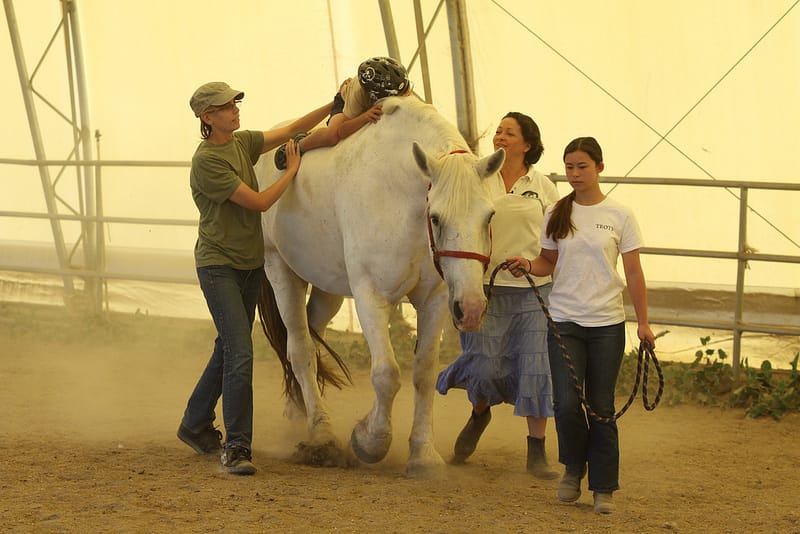
Why Horse Movement Can Be Useful
A walking horse generates a steady, three-dimensional motion that resembles the movements of human gait. Sitting astride, with support as needed, the participant's pelvis and trunk respond to each step. This living treatment surface can offer several things at once.
A steady postural challenge. The trunk and hips activate repeatedly to stay centered, helping build endurance, midline awareness, and control.
Opportunities for weight shift and symmetry. As the horse moves through turns, circles, and direction changes, the rider practices organizing both sides of the body.
Sensory input inside a meaningful task. Vestibular, proprioceptive, and tactile cues come packaged in an activity that feels purposeful rather than repetitive.
Clinicians adjust the experience by choosing a particular horse, varying stride length, modifying speed, riding figures, or layering in functional tasks such as reaching, timing breath with movement, or planning a simple sequence.
What the Research Suggests
Most research on hippotherapy for cerebral palsy has focused on children, and the body of evidence has grown over the past decade. The findings are encouraging but still limited, which is part of why clinicians describe hippotherapy as a supportive strategy rather than a proven standalone treatment.
A 2020 systematic review and meta-analysis of ten randomized controlled trials, involving 452 children, reported favorable effects on gross motor function, while its authors cautioned that the overall evidence base remains limited.2 A larger 2025 systematic review of twenty-five studies, covering more than 600 children, reached a similar conclusion: hippotherapy can improve gross motor function in children with cerebral palsy.3 Other reviews have examined related outcomes such as postural control and balance.
Two honest caveats belong next to those results. Study designs and quality vary, so confidence in the exact size of any effect is modest. And cerebral palsy is a lifelong condition: hippotherapy is studied as a way to support function and participation, not as a cure. Evidence in adults is thinner than in children, and what is right for any individual is a decision for their care team.
How Goals Are Approached in PT, OT, and Speech
Because cerebral palsy presents differently across individuals, treatment goals vary widely. Still, some common themes appear in educational descriptions of hippotherapy-supported goals.
Physical therapy approaches. PTs may use horse movement to help a participant organize the trunk, coordinate head and neck control, improve transitions between positions, or develop steadier balance strategies that support walking or standing.
Occupational therapy approaches. OTs often pair postural demand with functional tasks: grasp and release, bilateral coordination, reaching across midline, or maintaining alignment during short activity sequences.
Speech-language approaches. SLPs might incorporate mounted tasks that encourage pacing, sustained phonation, breath support, prosody, or attention, when those skills are already part of a speech-language therapy plan.
Mounted work is used only when appropriate for the participant's body, safety profile, and goals. Many sessions include meaningful groundwork before or after mounted activities.
What a Session Typically Looks Like
Although each program has its own flow, many sessions follow a calm, predictable structure that helps participants prepare, take part, and wind down.
Arrival and Goal Review
Families share updates, and the therapist highlights one or two targets for the session — for example, level sitting during turns, or steady breath for two short phrases.
Mounting and Setup
Helmet check, tack inspection, and mounting using a block, ramp, or mechanical lift. Side walkers join only when alignment or safety requires it.
Activity With the Horse
As the horse walks, the therapist shapes tempo, figures, and transitions while layering in tasks such as reaching, tapping across midline, tracking a visual target, or pairing breath with movement, observing comfort and engagement throughout.
Cool-Down and Dismount
The tempo slows, and the participant practices the same alignment off the horse — tall sitting on a bench, gentle stepping, or a short breathing routine.
Home Connection
The session usually ends with one simple cue to use during the week, such as "tall, then step," "soft ribs," or "pause and breathe before moving."
Where Progress Often Shows Up
Real-world changes tend to appear gradually. They may include more symmetrical sitting or less collapse to one side, steadier steps or easier navigation of stairs, improved tolerance for tabletop tasks, better coordination of reach, grasp, and release, and increased breath control for speech or sustained vocalization.
Clinicians track progress through session notes, periodic re-evaluations, standardized tools when appropriate, and shared observations from school teams and families.
Safety and Screening
Because hippotherapy is used within licensed therapy practice, safety screening is thorough and essential. Programs typically review medical history, discuss precautions, and request physician clearance when needed. Screening often considers:
- orthopedic stability of the spine and hips
- seizure history and control
- bone density and fracture risk
- respiratory or cardiac concerns
- skin integrity and tolerance for positioning
- allergies to horses or hay
If mounted work is not appropriate, many goals can still be addressed through groundwork or clinic-based strategies.
Horse Welfare
The horse is an active partner, not a piece of equipment. High-quality programs select horses for temperament and movement, limit workloads, monitor comfort, and adjust or stop sessions when a horse shows signs of stress. Respectful handling and clear communication protect both horses and participants.
Adaptation and Inclusion
Because cerebral palsy affects each person differently, clinicians tailor sessions thoughtfully. Adaptations may include supportive pads or surcingles for alignment, visual schedules or brief verbal cues, frequent breaks or quieter barn times, positioning aids for trunk or head support, and alternatives such as carriage driving or groundwork. The goal is always the same: set up a safe experience where the participant can work, succeed, and feel respected.
Working With Families and Care Teams
Hippotherapy tends to work best when it is aligned with school therapy, clinical care, and home routines. Families often choose one functional focus for the month — for example, a wider base when stepping, or steady breath before speaking. Using the same cue in every setting helps improvements transfer.
Choosing a Hippotherapy Program
A visit can reveal a great deal. Strong programs tend to share a few traits:
- licensed clinicians who can explain the approach clearly
- calm horses and clean, well-fitted tack
- accessible mounting areas
- staff who coach rather than rush
- predictable routines and transparent communication
- thoughtful explanations of how horses are selected and rested
Above all, it should feel safe, respectful, and collaborative.
A Short Vignette
A young rider with spastic diplegia tends to collapse through one side while sitting and adopts a very narrow base when walking. During a session, the therapist selects a steady horse and rides slow figure-eight patterns. At each change of bend, they cue the rider to imagine growing tall to the inside while lightly contacting the outside thigh.
By the end of the session, the rider steps down the ramp with a noticeably wider, more stable base. The family carries home a simple cue — "tall, then step" — and over time it becomes part of getting in and out of the car, walking to class, and crossing the living room.
Conclusion
Hippotherapy does not replace clinic-based therapy. It expands it, offering a dynamic surface that challenges posture, balance, breath coordination, and functional movement in a motivating, real-world setting.
When used by licensed clinicians, with careful screening and a strong horse-welfare ethic, it can reinforce the skills that matter most — sitting comfortably, moving with more confidence, communicating with more ease, and navigating everyday life with greater stability. To find a program, you can browse centers by state in our directory.
SOURCES
- American Hippotherapy Association — definition of hippotherapy as a treatment strategy within licensed scope of practice. americanhippotherapyassociation.org
- Lucena-Antón D. et al. (2020). The Effectiveness of Hippotherapy to Recover Gross Motor Function in Children with Cerebral Palsy: A Systematic Review and Meta-Analysis. (PMC7552760)
- Bernardino I. et al. (2025). Hippotherapy Improves Gross Motor Function in Children with Cerebral Palsy: Evidence from a Systematic Review. (PubMed 41160425)
This guide is for general information and isn’t medical or mental-health advice. Talk with a qualified provider about your own situation.