
Hippotherapy and Horse Movement: How a Horse’s Gait Becomes a Clinical Tool
Learn how licensed PTs, OTs, and SLPs use horse movement in treatment, who benefits, safety basics, and how to choose a quality hippotherapy program.
On this page
- Why a Horse's Movement Is Unique
- What the Movement Does in the Body
- How Clinicians Shape the Movement
- Movement, Not a Riding Lesson
- What a Session Looks Like
- How the Movement Translates to Daily Life
- What the Research Suggests
- Safety, Screening, and Horse Welfare
- A Complement, Not a Replacement
- Finding a Program
Hippotherapy is the way licensed physical, occupational, and speech-language therapists use a horse's movement as a tool within treatment. It isn't a riding lesson and isn't a stand-alone service — it's one part of an individualized therapy plan, in which the rhythmic, multidirectional motion of a walking horse becomes something a clinician can shape toward specific goals. What makes it distinctive isn't the barn; it's the movement, and what a trained therapist can do with it.
This guide focuses on that movement: why a horse's gait is so hard to replicate with clinic equipment, what it does inside the body, and how a clinician turns it into precise, goal-directed input. For a broader overview of hippotherapy — its benefits, who it serves, and how to choose a program — see our companion guide on what hippotherapy is and how it works.
Why a Horse's Movement Is Unique
When a horse walks, its back and the rider's pelvis move through a rhythmic, three-dimensional pattern that closely resembles the motion of human walking — forward and back, side to side, and in subtle rotation, all at once. Sitting astride that motion, a person's body has to make continuous postural adjustments simply to stay aligned. No standard clinic device reproduces this combination of variability, rhythm, and gait-like input.
That's the core of why clinicians use it. The horse supplies a living, moving surface that constantly asks the trunk and pelvis to respond — and because the therapist can change the horse's speed, direction, and path, that input can be dialed up, smoothed out, or redirected to suit the moment. The American Hippotherapy Association frames hippotherapy precisely this way: not as a therapy in itself, but as how an OT, PT, or SLP uses equine movement as a treatment tool to engage sensory, neuromotor, and cognitive systems toward functional goals.1
What the Movement Does in the Body
Each stride invites a cascade of small responses. The pelvis tilts and rotates, the trunk counter-adjusts, and the postural muscles fire and relax in sequence to keep the body centered. For a clinician, those continuous adjustments are an opportunity to work on alignment, core engagement, timing, and body awareness — not through repetition of a single exercise, but through a constantly varying challenge the body has to keep meeting. Mechanism studies have observed measurable changes in trunk and head stability in children with cerebral palsy following hippotherapy, which points to the postural-control system as one place the movement does real work.2
There's a sensory dimension too. A smooth, predictable walk delivers organized vestibular and proprioceptive input, while grooming and leading add graded tactile information in a structured, tolerable way. The barn itself offers manageable sensory variety — temperature, natural sound, open space — that a therapist can adjust to a person's comfort. The result is a setting where motor and sensory work happen together, woven into an activity that feels purposeful rather than clinical.
How Clinicians Shape the Movement
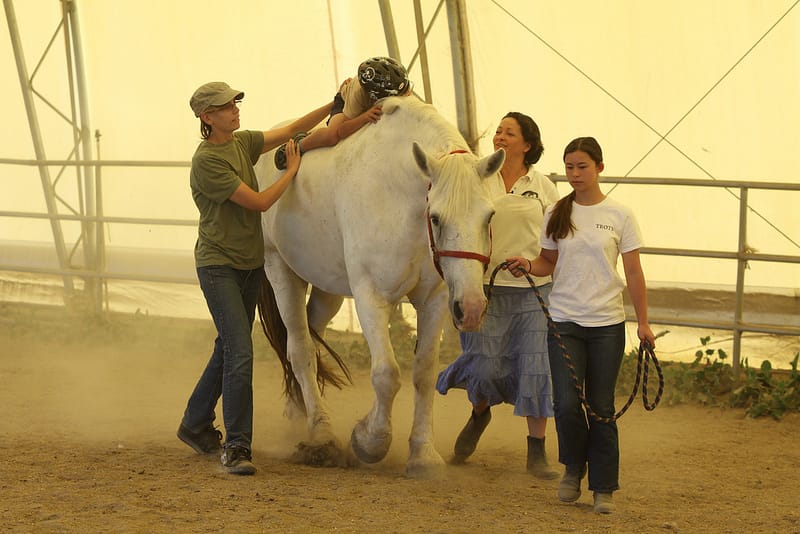
The therapist directs the session, not the horse — and most of the skill lies in shaping the movement variables. That might mean selecting a horse with a particular stride length or rhythm, adjusting walking speed, riding circles or serpentines, or pausing for stop-and-start transitions. The rider might sit centered with hands free, face sideways, or perform small tasks within safe limits, each position changing how the movement loads the body.
The discipline shapes the goal. A speech-language therapist might pair breath or voicing phrases with the steady rhythm of the walk. An occupational therapist might fold in reaching, grasp-and-release, or sequencing while the rider maintains midline. A physical therapist might emphasize core activation, controlled weight shifts, or more symmetrical alignment through changes of direction. Every adjustment in tempo or path creates a different blend of sensory and motor input, and the therapist tracks how the person responds, folding those observations back into the treatment plan.
Movement, Not a Riding Lesson
Because horses are involved, hippotherapy is easy to confuse with riding programs — but the distinction is real and clinical. Hippotherapy is directed by licensed healthcare professionals applying clinical reasoning toward measurable goals, whereas therapeutic and adaptive riding teach horsemanship and focus on participation and enjoyment, and equine-assisted psychotherapy is mental-health work led by licensed therapists. The full breakdown of these distinctions lives in our comparison of adaptive and therapeutic riding. In hippotherapy, the rider isn't learning to ride — the movement is being used to treat.
What a Session Looks Like
Sessions vary, but most follow a steady rhythm. The therapist opens with a brief check-in to note what's changed since last time and to set the day's focus, then handles helmet fit and equipment calmly and consistently. Mounting happens via block, ramp, or mechanical lift depending on access needs.
Once the person is mounted or engaged in groundwork, the therapist shapes the activity moment by moment — straight lines at first, then gentle curves, changes of direction, or stop-and-start transitions, with short tasks like reaching, tapping, voicing, or following a sequence layered in. These serve the clinical goal, not the riding experience. As the session winds down, the tempo slows and the therapist reinforces carryover: practicing the same posture on a bench, repeating a breath phrase off the horse, or naming one thing to focus on during the week. A predictable closing routine helps anchor the experience.
How the Movement Translates to Daily Life
Because hippotherapy sits within licensed practice, goals are concrete and measurable — how long someone holds neutral alignment, how well they shift weight while the horse walks, whether they can coordinate breath with speech under gentle postural demand. Therapists document with the same standardized measures, checklists, caregiver reports, and comparison tasks they'd use in a clinic.
What that looks like in practice is small and cumulative. Picture a child who tends to collapse to one side when sitting. A physical therapist chooses a horse with even, steady movement and walks gentle figure-eights, so the child practices growing tall through alternating sides of the trunk. Over several weeks, those moments of controlled alignment start showing up off the horse — sitting more symmetrically at meals, reaching with more ease, feeling steadier stepping onto playground equipment. The movement does its work one shaped stride at a time, and the gains accumulate where they actually matter.
What the Research Suggests
The evidence is worth stating plainly. The strongest and most consistent findings for equine movement as a clinical tool are in gross motor function and postural control, and they're clearest in children with cerebral palsy, where meta-analyses have reported meaningful improvements.3 Mechanism-level studies add support by showing changes in trunk and head stability that help explain how the movement produces those gains.2
Evidence for broader applications — across speech, sensory processing, and other populations — is more preliminary, often drawn from smaller studies. That doesn't undercut the approach; it means hippotherapy is best understood as a well-reasoned treatment tool with solid support in specific areas and growing evidence elsewhere, applied by a clinician who's tracking whether it's working for a given person.
Safety, Screening, and Horse Welfare
Because the work involves movement and weight bearing, screening is essential. A licensed therapist reviews medical history and determines whether any condition calls for modification or makes mounted work unsafe, coordinating with a person's other healthcare providers and designing groundwork or therapeutic-driving alternatives when those are the safer fit. Helmets are required for mounted work, sidewalkers or spotters are added as needed, and the clinician and an equine specialist monitor both person and horse throughout for signs of fatigue or stress.
The horse's wellbeing is part of the safety equation, not separate from it. Therapy horses are selected for temperament, movement quality, and soundness, conditioned for the work, rotated appropriately, and given rest and choice — because a comfortable, well-supported horse provides the clearest, safest movement to work with.
This information is educational only and not a substitute for medical advice. Whether hippotherapy is appropriate for a given person must be determined by a licensed clinician.
A Complement, Not a Replacement
Hippotherapy doesn't replace conventional therapy — it's one tool within a broader clinical plan, used alongside the rest of a person's care rather than in place of it. The therapist still sets goals, tracks progress, and integrates what happens at the barn into the wider work a person is doing with their care team. The horse's movement adds something static equipment can't, but it's the clinical reasoning around it — and the coordination with everyone else involved — that makes it therapy.
Finding a Program
A strong program can clearly explain how hippotherapy fits within clinical practice, who leads sessions, how horses are selected, and how progress is tracked — and families should feel comfortable asking about credentials, safety procedures, equipment, horse welfare, and how the team coordinates with other providers. Transparency and unhurried, respectful pacing are good signs.
When you're ready to look, you can find a program near you or browse centers by state. Coverage and scheduling vary widely between programs, and many can explain their billing and scholarship options.
SOURCES
- American Hippotherapy Association. Hippotherapy as a treatment tool: how occupational therapy, physical therapy, and speech-language pathology professionals use equine movement. americanhippotherapyassociation.org
- Shurtleff TL, Engsberg JR. Changes in trunk and head stability in children with cerebral palsy after hippotherapy: a pilot study. Physical & Occupational Therapy in Pediatrics, 2010.
- Tseng SH, Chen HC, Tam KW. Systematic review and meta-analysis of the effect of equine-assisted activities and therapies on gross motor outcome in children with cerebral palsy. Disability and Rehabilitation, 2013.
This guide is for general information and isn’t medical or mental-health advice. Talk with a qualified provider about your own situation.