What Is Equine Therapy? A Complete Guide to Equine-Assisted Programs*

Learn what equine therapy is, the different types, how it works, and who it may help.

SUMMARY
Equine therapy is a broad term for horse-based services that may support physical, emotional, cognitive, or social goals. It can include therapeutic riding, hippotherapy, equine-assisted learning, and mental health-focused programs, depending on how the service is structured and who leads it.

NOTE: This article is intended for informational purposes only and does not constitute medical, psychological, or therapeutic advice. Families and caregivers should consult qualified healthcare professionals when making decisions about therapeutic services for themselves or their loved ones.

Equine therapy is one of the most distinctive and rapidly growing areas in rehabilitation, mental health, and special education. It draws on the unique relationship between humans and horses to help people achieve physical, cognitive, emotional, and social goals that can be difficult to reach through conventional therapeutic approaches alone. Yet despite growing public awareness, there remains significant confusion about what equine therapy actually means — which programs it includes, how they differ from one another, who they serve, and what the evidence says about their effectiveness.

This guide answers those questions. It covers the full spectrum of equine-assisted programs practiced in North America today, explains what distinguishes one from another, and helps families, caregivers, educators, and referring professionals understand which type of program might be worth exploring for a given person and goal.

The Term “Equine Therapy”: What It Does and Doesn’t Mean

The phrase “equine therapy” is used loosely in everyday conversation to refer to almost any structured activity involving horses and people with special needs or health goals. That broad usage is understandable — and this article will use it as a general umbrella term — but it is important to understand that from a professional standpoint, “equine therapy” encompasses several distinct and carefully defined program types, each with its own practitioner credentials, professional standards, funding landscape, and evidence base.

The governing body for equine-assisted services in the United States is PATH International (Professional Association of Therapeutic Horsemanship International). In Canada, the equivalent body is CanTRA (Canadian Therapeutic Riding Association). These organizations accredit centers, certify instructors, and define the terminology used in the field. Families searching for programs will frequently encounter PATH-accredited or CanTRA-certified centers, and that designation matters: it signals that the facility has been independently reviewed against standards for safety, program quality, horse welfare, facility management, and instructor training.

In Québec specifically, the Fédération québécoise d’équitation thérapeutique (FQET) plays a similar provincial role, certifying centers and promoting standards for therapeutic riding practice.

Therapeutic Riding

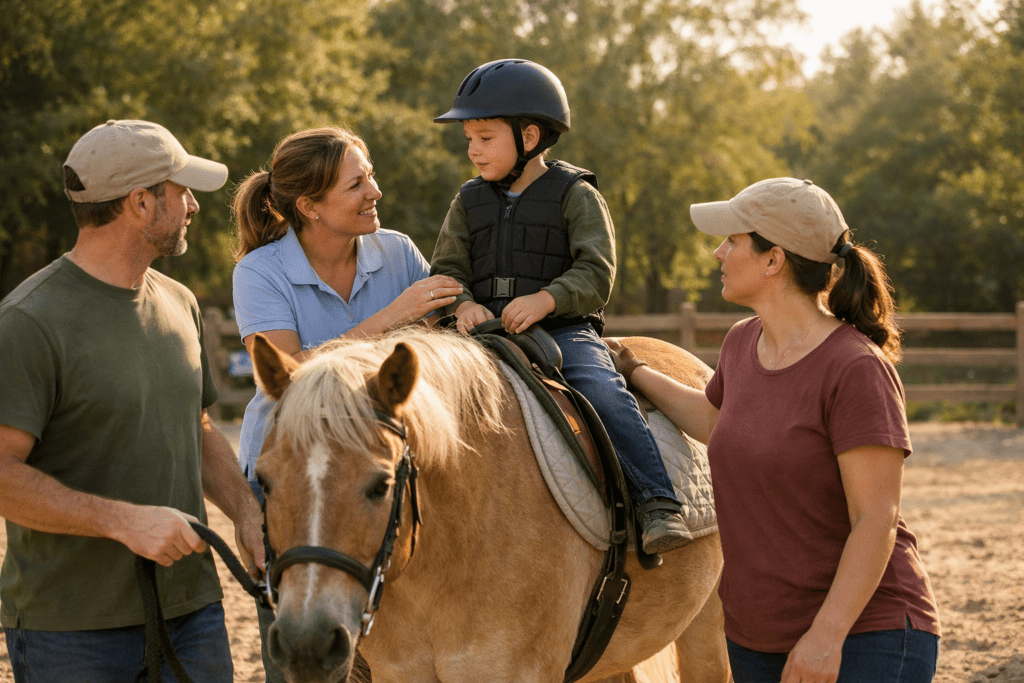
Therapeutic riding is the most widely practiced and publicly recognized form of equine therapy. It is an equestrian skill-based activity conducted by a certified therapeutic riding instructor, in which a participant rides a horse in private or group lessons that are specifically adapted to their physical, cognitive, emotional, or behavioral needs.

Therapeutic riding is not hippotherapy (a distinction that will be explained below), though the two are frequently confused. The key difference is that therapeutic riding is a goal-directed recreational and educational activity led by a certified instructor, while hippotherapy is a clinical treatment delivered by a licensed therapist. Both involve a mounted rider, but their purposes, practitioners, and billing structures are different.

In a therapeutic riding session, the instructor designs activities that use the horse and the arena environment as tools for working toward specific rider goals. A rider working on core strength might be asked to ride without stirrups. A rider building communication skills might practice giving clear vocal commands to the horse. A rider with attention challenges might work through a series of cone patterns or obstacle courses designed to sustain focus. The instructor observes, adjusts, and documents progress toward goals that are set collaboratively with the rider, their family, and any other professionals involved in their care.

Volunteers play an essential and structured role in most therapeutic riding programs. Side-walkers walk alongside the horse to provide physical support and safety, while horse leaders guide the animal through the arena. This volunteer model makes therapeutic riding accessible for participants who would not be safe or independent on horseback without additional support — and it creates meaningful community engagement opportunities at every center.

Reported benefits of therapeutic riding span multiple domains. Physical benefits observed in participants include improved balance, coordination, muscle tone, strength, posture, and range of motion. The horse’s walk closely approximates the human gait pattern — a three-dimensional, rhythmic movement that activates the rider’s postural muscles in ways that are neurologically meaningful, particularly for people who use wheelchairs or walkers and rarely experience that movement pattern in daily life. Cognitive benefits reported by instructors and families include improved attention, sequencing, spatial awareness, and problem-solving. Emotional and social benefits include increased self-confidence, reduced anxiety, improved communication, and the experience of a non-judgmental relationship with an animal. Individual results vary, and outcomes depend on the participant’s diagnosis, goals, frequency of participation, and the quality of the program.

PATH International certifies therapeutic riding instructors through a rigorous training and examination process. The credential CTRI (Certified Therapeutic Riding Instructor) is the field’s primary mark of professional qualification.

Hippotherapy

Hippotherapy — from the Greek “hippos,” meaning horse — is a clinical treatment strategy in which a licensed physical therapist, occupational therapist, or speech-language pathologist uses the movement of the horse as a treatment tool to address specific functional goals.

This distinction is critical: in hippotherapy, the therapist is the service provider, not a riding instructor. The horse’s movement is used as a therapeutic medium — not the riding activity itself. The therapist selects and directs the horse’s gait, speed, and direction in response to what they observe in the client’s neuromuscular and sensory responses, much as they would select and adjust any other treatment modality in a clinical setting.

A physical therapist using hippotherapy might work with a child with cerebral palsy, using the horse’s rhythmic movement to facilitate improved weight shifting, trunk control, and hip symmetry — goals that align directly with the child’s physical therapy plan. A speech-language pathologist using hippotherapy might work with a child with autism spectrum disorder, using the horse’s movement and the novelty of the equine environment to facilitate vocalization, turn-taking, and eye contact. An occupational therapist might use hippotherapy to address sensory processing goals, postural stability, or fine motor function.

Because hippotherapy is a clinical treatment delivered by licensed therapists, it may be covered by health insurance in some circumstances. Coverage varies significantly by insurer, state or province, diagnosis, and individual policy — families should contact their insurer directly and request a benefits determination before assuming coverage applies.

The American Hippotherapy Certification Board (AHCB) offers the Hippotherapy Clinical Specialist (HCS) credential for licensed therapists who have met specialized training and clinical hour requirements in hippotherapy. Many therapeutic riding centers that offer hippotherapy partner with rehabilitation hospitals or therapy practices to bring licensed clinicians onto their premises.

Equine-Facilitated Mental Health (EFMH) and Equine-Assisted Psychotherapy (EAP)

Equine-facilitated mental health (EFMH) and equine-assisted psychotherapy (EAP) are non-mounted, ground-based programs in which a licensed mental health professional works with a client or group in the presence of horses to address psychological, emotional, relational, and behavioral goals.

The horse is not ridden in these programs. Instead, clients interact with horses on the ground — observing, grooming, leading, or engaging in structured activities alongside the horse — while the mental health professional facilitates the experience and helps the client draw meaning, insight, and new patterns of behavior from what emerges in the interaction.

Horses are particularly well-suited to mental health applications because they are extraordinarily sensitive to human emotional states. As prey animals with highly developed social awareness, horses respond moment-to-moment to the energy, body language, and emotional regulation of the people around them. When a person approaches a horse with anxiety, the horse notices. When that same person slows their breathing and grounds their body, the horse responds differently. This responsiveness creates a real-time feedback loop that a skilled mental health clinician can use to help clients explore their own emotional and relational patterns in ways that talking alone may not achieve.

EFMH programs are used with a wide range of populations: adolescents with behavioral challenges, trauma survivors, people with post-traumatic stress disorder (PTSD), veterans, individuals in substance abuse recovery, at-risk youth, people experiencing grief or life transitions, and those working through relational or family challenges. They are also used in school-based programs, correctional settings, and residential treatment contexts. These programs are not a replacement for conventional mental health treatment and should be pursued in coordination with a participant’s existing care team where one is in place.

The most widely recognized framework for equine-assisted psychotherapy is EAGALA (Equine Assisted Growth and Learning Association), which trains and certifies teams of mental health professionals and equine specialists who co-facilitate sessions together. The EAGALA model is strictly ground-based and solution-focused, with the horse’s behavior treated as a primary source of information throughout the session.

Equine-Facilitated Learning (EFL) and Equine-Assisted Learning (EAL)

Equine-facilitated learning (EFL) and equine-assisted learning (EAL) are ground-based, educational programs that use horses and the barn environment to develop life skills, leadership, team-building, communication, confidence, and resilience — without a formal clinical or therapeutic framework.

These programs are not therapy and do not require a licensed mental health professional to facilitate. They are more akin to structured experiential education, and they are offered in a wide variety of settings: corporate team-building programs, school enrichment programs, summer camps, leadership development curricula, and community programs for at-risk youth.

In an EFL or EAL program, participants might be asked to work in pairs to complete a ground-based challenge with a horse — moving the horse through an obstacle course using only body language and gentle pressure, for example — and then reflect on what the experience revealed about communication, trust, leadership, and collaboration. The horse serves as a mirror and a teacher, responding honestly to how the human shows up.

While EFL and EAL are distinct from clinical therapy, many therapeutic riding centers offer EAL programming as part of their broader service menu, recognizing that not every person who can benefit from equine-assisted experiences needs a clinical intervention.

Therapeutic Horsemanship

Therapeutic horsemanship is a broader term used by PATH International to encompass mounted and non-mounted equine-assisted activities that develop skills in horse care, handling, and riding while simultaneously working toward cognitive, emotional, social, and behavioral goals. Therapeutic horsemanship includes therapeutic riding but also encompasses horse-master lessons, Pony Club curriculum, horse care instruction, and competitive equestrian activities adapted for participants with special needs.

Some centers offer therapeutic horsemanship programs that progress riders through genuine equestrian skill development — grooming, tacking, groundwork, riding at walk, trot, and canter — within a therapeutic framework. For participants whose goals include genuine equestrian competence alongside therapeutic outcomes, this model offers a pathway to meaningful horsemanship skills that builds on itself over time.

Therapeutic Driving

Therapeutic driving is an adapted carriage driving activity in which a participant drives a horse-drawn vehicle under the supervision of a certified instructor. It serves as an alternative to mounted riding for participants who are contraindicated for riding — due to spinal instability, severe spasticity, osteoporosis, or other physical conditions — but who may still benefit from equine movement and the therapeutic relationship with the horse.

From a seated position in the carriage, the driver experiences the horse’s movement transmitted through the reins and the vehicle, which continues to offer sensory, motor, and cognitive stimulation while eliminating the risks associated with being mounted on horseback. Therapeutic driving also requires active engagement — steering, communicating with the horse through the reins, managing speed and direction — which may support fine motor development, attention, executive function, and a sense of agency and accomplishment. As with all equine-assisted services, suitability for therapeutic driving should be assessed by qualified professionals familiar with the participant’s medical history and functional profile.

Equine-Assisted Services for Veterans: Horses for Heroes

Programs specifically designed to serve veterans, active duty military personnel, and their families represent one of the fastest-growing segments of the equine therapy field. PATH International’s Equine Services for Heroes program provides a framework and certification for centers offering equine-assisted services to military populations, and many centers across North America offer free or reduced-cost sessions to veterans as part of their program mission.

Veterans’ programs draw on the full spectrum of equine-assisted modalities — therapeutic riding, EFMH, EAL, and groundwork — adapted to the specific challenges faced by those returning from military service, including PTSD, traumatic brain injury, moral injury, depression, anxiety, and the complex social and emotional experience of reintegrating into civilian life. These programs are intended as complementary support and are most effective when coordinated with a veteran’s existing healthcare and mental health providers.

The horse’s non-judgmental nature is frequently cited by veterans as one of the most meaningful aspects of equine therapy. Horses respond to the person in front of them in the present moment, without history, stereotype, or expectation — an experience that many veterans describe as uniquely safe and meaningful at a time when human relationships may feel fraught or difficult.

Para-Equestrian Sport

For riders with physical disabilities who are ready to pursue competitive equestrian sport, para-equestrian offers a formal competition pathway. Para-dressage is the primary para-equestrian discipline in North America, governed by Equestrian Canada and the United States Equestrian Federation, and offered at the Paralympic level through the FEI (Fédération Équestre Internationale).

Para-equestrian riders are classified into grades based on the functional impact of their disability on their riding, and tests are adapted accordingly. Some therapeutic riding centers support para-equestrian riders in their competitive aspirations, offering training that bridges the therapeutic and competitive equestrian worlds.

Adaptive Riding

Adaptive riding refers to equestrian instruction that has been modified to accommodate the needs of riders with physical or cognitive disabilities, but that is oriented primarily toward recreational enjoyment and equestrian skill development rather than therapeutic goals. It sits at the intersection of equine therapy and general recreational riding.

Many families find that as their child or family member gains confidence and ability through therapeutic riding, they transition naturally toward adaptive riding as their goals shift from therapeutic to recreational and competitive. Centers that offer both create a valuable continuum of equestrian experience.

Who Benefits from Equine Therapy?

Equine therapy programs serve an extraordinarily broad population. The following conditions and populations are commonly represented across equine-assisted services programs, though this list is not exhaustive and suitability for any individual should always be assessed by qualified professionals at an accredited center.

Neurological and developmental conditions such as autism spectrum disorder, cerebral palsy, Down syndrome, traumatic brain injury, multiple sclerosis, and stroke are well-represented in therapeutic riding and hippotherapy populations, where the physical and sensory dimensions of equine movement may offer benefits that complement conventional rehabilitation approaches.

Orthopedic and physical conditions including limb differences, spina bifida, muscular dystrophy, and post-surgical recovery are addressed through hippotherapy and therapeutic riding, where equine movement may facilitate strength, range of motion, and motor skill development under the direction of qualified clinicians.

Mental health conditions — anxiety, depression, PTSD, attachment difficulties, grief, and trauma — are the primary focus of equine-facilitated mental health programs, which are always facilitated by licensed mental health professionals.

Learning and behavioral challenges including ADD, ADHD, learning disabilities, and behavioral disorders are commonly served through both therapeutic riding and equine-facilitated learning, as complementary supports alongside other educational and clinical interventions.

Social and communication challenges, including those associated with autism and intellectual disabilities, are addressed across the full range of equine therapy modalities, where the horse can serve as a powerful motivator for engagement and communication.

Life challenges and transitions — addiction recovery, reintegration after incarceration, bereavement, and family crisis — are the domain of EFL and EFMH programs serving community populations. These programs are not a substitute for clinical treatment where clinical treatment is indicated.

Choosing the Right Program

Finding the right equine therapy program begins with clarifying what the participant needs and what outcomes matter most. Consulting with the participant’s physician, therapist, or other treating professional before beginning any equine-assisted program is strongly recommended, both to ensure medical suitability and to coordinate goals across the participant’s care team.

A few key questions can help focus the search:

Is the goal primarily physical rehabilitation?Hippotherapy delivered by a licensed physical or occupational therapist, or therapeutic riding with physical rehabilitation goals at a PATH Premier Accredited or CanTRA-certified center with therapist involvement, is likely the most appropriate starting point.

Is the goal primarily mental health or emotional? An EFMH or EAP program facilitated by a licensed mental health professional using a recognized model such as EAGALA is the appropriate framework — and it should be coordinated with any existing mental health treatment.

Is the goal a combination of physical, cognitive, and social development?Therapeutic riding at an accredited center, with a certified instructor who communicates with the participant’s existing therapy team, is the most common and broadly applicable entry point.

Is the person a veteran?Centers participating in PATH’s Equine Services for Heroes program, or those with specific military programming, offer the most targeted experience, and coordination with VA healthcare providers is encouraged.

Accreditation matters. PATH Premier Accredited Centers have met the highest standards in the field. CanTRA-certified centers in Canada and FQET-certified centers in Québec carry equivalent provincial credentialing. These designations reflect a genuine commitment to safety, instructor quality, horse welfare, and program integrity that families and referring professionals can rely on.

The Evidence Base for Equine Therapy

Research on equine therapy has grown substantially over the past two decades, though the field faces the same methodological challenges that confront many complementary and behavioral health interventions: small sample sizes, heterogeneous populations, difficulty blinding participants and assessors, and the challenge of defining and measuring outcomes that are inherently multi-dimensional. Families and referring professionals should approach the evidence base with appropriate context rather than treating any single study as definitive.

With those caveats in mind, the current body of peer-reviewed research offers encouraging findings across several populations. Studies examining hippotherapy in children with cerebral palsy have demonstrated improvements in postural control, trunk stability, and gait parameters in multiple controlled trials. Research on therapeutic riding has found positive associations with balance, muscle strength, and functional mobility across several disability populations. Equine-assisted interventions for children with autism have shown improvements in social communication, adaptive behavior, and sensory processing in multiple pilot studies. Several trials examining equine-assisted psychotherapy in veterans with PTSD have reported reductions in symptom severity.

The research base continues to grow, and larger, more rigorously designed studies are underway. The current evidence is sufficient to support equine therapy as a potentially valuable complementary or adjunctive approach for many of the populations served — particularly when delivered by qualified practitioners at accredited centers, alongside rather than in place of conventional medical or therapeutic care. Families considering equine therapy are encouraged to discuss the evidence with their healthcare providers and to ask centers directly about how they measure and document participant progress.

Finding an Equine Therapy Program

The EquestrianTherapy.com directory is one of the most comprehensive resources available for finding equine-assisted services centers across the United States and Canada. Centers can be searched by location and program type, with listings for therapeutic riding, hippotherapy, equine-facilitated mental health, adaptive riding, veterans programs, and more.

PATH International maintains its own member center directory at pathintl.org, searchable by state and program type. CanTRA’s directory covers Canadian centers at cantra.ca. EAGALA maintains a directory of certified practitioners at eagala.org for families specifically seeking equine-assisted psychotherapy.

When contacting a center, families should ask about accreditation status, instructor credentials, the intake and assessment process, how the program communicates with other members of the participant’s care team, and what the typical session structure looks like. A well-run center will welcome these questions and answer them clearly — that transparency is itself a meaningful indicator of program quality.

The information in this article reflects general educational content about equine-assisted services and is not a substitute for professional medical, psychological, or therapeutic advice. Always consult qualified healthcare professionals before beginning any new therapeutic program.

Equine therapy, in all its forms, offers something genuinely rare in the landscape of therapeutic and educational services: a living, responsive, non-judgmental partner whose presence changes what is possible for the people who work with them. Whether the goal is walking more steadily, speaking more freely, processing a trauma, or simply experiencing the joy of riding, the horse meets the person where they are — and that, more than any clinical framework, may be the deepest reason why equine therapy works.

Leave a Comment

Previous

How to Find PATH Accredited Equine Therapy Centers

Next

Adaptive Riding vs Therapeutic Riding: Key Differences Explained