Cost and Funding
Equine Therapy Grants and Funding Options
There is rarely one grant that covers it all. Most families fund equine therapy by stacking pieces — a partial scholarship, a local donation, a small grant. Here is where the money comes from.
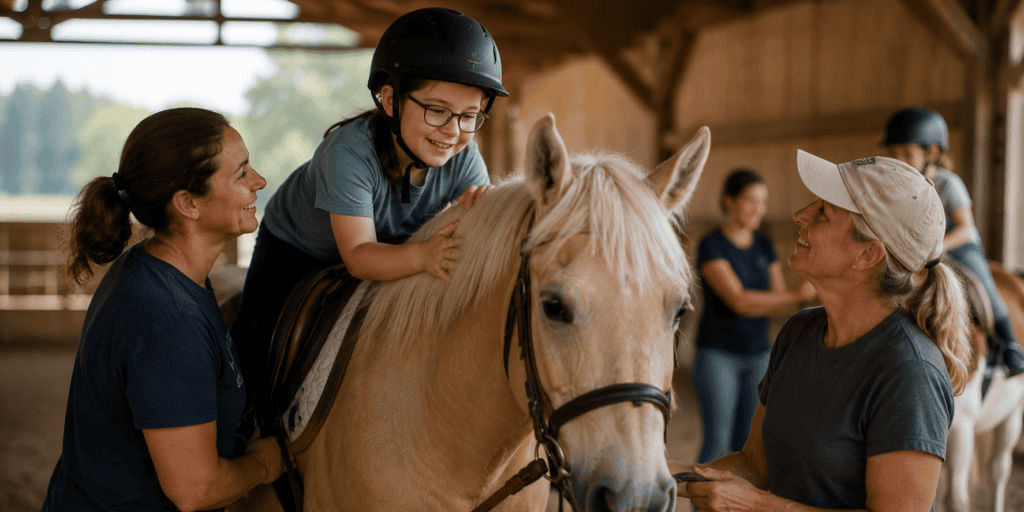
For many people, the cost of equine therapy is the biggest barrier to starting — session fees, travel, and ongoing participation add up, and the real question is often not whether a program is worthwhile but whether it is financially realistic over time.
The encouraging part is that support exists. It is rarely simple or universal, but grants, scholarships, public funding, veteran programs, and local giving can all lower out-of-pocket costs, and most families succeed by combining several sources rather than relying on any one.
This guide maps where the money tends to come from, how to start, and what to ask. What applies to you depends on the program, where you live, and whether the service is clinical or non-clinical.
Where Funding Comes From
Support usually comes from a mix of private, nonprofit, and public sources. Here is the landscape at a glance.
| Source | What it is and who it helps | Where to start |
|---|---|---|
| Program scholarships | Reduced-fee or sponsored spots offered by the center itself | Ask the center first |
| Nonprofit grants | National or regional foundations for therapy, adaptive recreation, or disability services | Search both nationally and locally |
| Medicaid waivers | State disability and community-support funding; clinical services fit more easily | Your state’s waiver programs |
| Veteran and military funding | Programs for veterans, often pre-funded by sponsors or donors | Veteran-specific centers |
| School and agency partnerships | Schools or disability and vocational agencies funding participation | Organizations already in your support plan |
| Community foundations and service clubs | Local civic, religious, or service groups; flexible and relationship-based | Local groups in your area |
| Fundraising and sponsorship | Online fundraisers, donors, workplace giving, and center sponsor programs | The center and your own network |
A few nuances are worth knowing. Clinical services such as hippotherapy delivered by licensed professionals tend to fit existing therapy and Medicaid frameworks more easily than non-clinical therapeutic riding, which is rarely covered directly.
Veteran-focused programs often have funding already built in. And local sources — community foundations, service clubs, faith groups — are frequently the most flexible and the easiest to overlook, because they are rooted in relationships rather than national competition.
Start With the Program Itself
The most direct place to begin is the center, especially nonprofit programs, which often offer scholarships or reduced-fee participation. The center already knows its own pricing, waitlists, and available aid, and it usually knows which outside funding sources past participants have used.
Some programs have formal scholarship applications; others simply offer limited help as funds allow. When you ask, find out whether aid is available, how often applications are reviewed, whether it covers full or partial tuition, and whether it applies to a single session, a season, or ongoing participation.
Beyond the Program
From there, work outward. In some states, Medicaid waiver programs may help cover services tied to therapy, disability support, or community participation — a complicated path, but worthwhile for families already using waiver services; our guide on insurance and funding covers that in more depth.
Nonprofit grants range from broad therapeutic-or-adaptive funding to highly specific aid tied to a diagnosis or population, so it pays to look both nationally and locally. Veterans and military families may find dedicated funding, sometimes already secured by the program. Schools, rehabilitation agencies, and disability or youth organizations sometimes fund participation when it fits a broader support plan. And fundraising — online campaigns, community sponsorships, workplace giving, or a center’s own donor-backed lesson program — ends up being part of the mix for many families.
It should not be the only answer, but for ongoing programs with strong local support, it can genuinely help.
Questions to Ask a Program
A few direct questions save time and tell you a lot about how accessible a program really is:
- Do you offer scholarships or financial aid?
- Have other families or adults used grants to pay for sessions?
- Do you work with veteran, disability, or school-based funding sources?
- Is your program a nonprofit?
- Are there sponsor or donor-supported lesson options?
- Is there a waitlist for reduced-fee participation?
What to Expect, and Final Thoughts
Funding rarely happens instantly. Grants can be seasonal, some have income requirements, and many cover only part of the cost — so people usually piece together support from several sources over time rather than landing one large award.
A partial scholarship, a community donation, and a small grant may be exactly what makes participation possible. That patchwork is normal, and the most useful mindset is to treat funding as a search for combinations rather than a single answer. It takes persistence and flexibility, but when the right pieces come together, equine therapy becomes far more accessible than it first appears.
To find programs and ask about aid directly, you can browse centers by state, and if you are weighing grants against scholarships specifically, see how the two differ.