
Equine Therapy for Cerebral Palsy: Benefits and Program Options
Learn how equine therapy supports individuals with cerebral palsy through movement, balance, and structured programs like hippotherapy and therapeutic riding.
On this page
Equine therapy for cerebral palsy uses the movement of a horse, in a structured and supported setting, to help build balance, posture, coordination, and confidence. The horse's steady, rhythmic motion asks the rider's body to respond and adjust continuously, which is why movement-based programs like hippotherapy and therapeutic riding can be a meaningful complement to a child's care. These programs are not a replacement for medical treatment and not a cure, but for the right participant they can add a motivating, hands-on environment alongside other services.
This guide is an overview of the program options, what to expect, and how to choose. It is educational only and not medical advice — before starting, talk with your child's physician and therapy team to confirm that equine therapy is medically appropriate and to coordinate goals.
What the Evidence Shows
Cerebral palsy has more research behind equine therapy than almost any other condition. Several systematic reviews and a meta-analysis of randomized trials have found that hippotherapy — equine movement used by a licensed therapist — can improve gross motor function, postural control, and balance in children with CP, with the clearest results for spastic CP at milder-to-moderate levels (GMFCS I–III).1, 2 Therapeutic riding shows promising but more limited evidence. These are real functional gains rather than a cure, and because the trials remain relatively small, equine therapy is best understood as one complement within a child's broader care. For a fuller look at the research, see our companion guide on hippotherapy for cerebral palsy.
Why Families Explore It
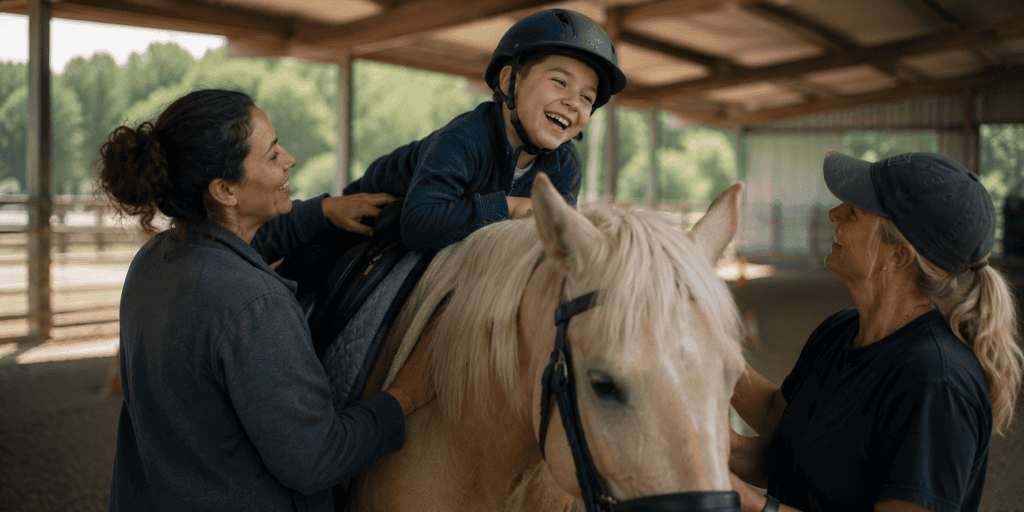
Beyond the research, families are often drawn to equine therapy because it feels different from a traditional clinic. The blend of movement, rhythm, and connection with a horse tends to support participation and engagement, and for a child with cerebral palsy, that motivation can make the repetitive, body-organizing work of balance and posture feel purposeful rather than like exercise.
Many families describe gains in body awareness, core stability, and confidence over time — though outcomes are not guaranteed and vary by individual and program.
Program Types
Several kinds of equine-assisted programs are commonly available, and they differ in who leads them and whether they are clinical.
| Program | Led by | What it offers |
|---|---|---|
| Hippotherapy | Licensed PT, OT, or SLP | Equine movement used within a clinical treatment plan for posture, coordination, and function |
| Therapeutic riding | Certified instructors (e.g., PATH Intl.) | Riding skills in a structured, supportive setting; supports balance and confidence, though not clinical therapy |
| Groundwork and unmounted | Instructors or facilitators | Grooming, leading, and interaction from the ground — a lower-intensity option |
The distinction matters: hippotherapy is a clinical service delivered by a licensed therapist who shapes the horse's pace and direction toward specific goals, while therapeutic riding and groundwork are structured, supportive activities rather than medical treatment. Groundwork can be a good starting point for someone not yet ready for mounted work or who benefits from a calmer setting.
What a Session Looks Like
Sessions vary by program but tend to follow a predictable structure. A participant usually begins by greeting and preparing the horse with staff support, then — in mounted sessions — rides with assistance while an instructor or therapist guides the activity and side walkers or a horse leader help with safety and positioning.
Activities might include simple patterns, transitions, or movement and balance exercises, and the session closes with a consistent routine. For a closer walk-through of a typical visit, see what to expect at a session.
Is It Right for the Individual?
Programs are usually adapted to a wide range of needs, and they tend to suit individuals who can participate safely with support, who benefit from structured movement-based activity, and who are comfortable around animals. Riding is not always required — groundwork offers meaningful participation entirely from the ground — and a good program will assess what level of support fits and whether mounted work is appropriate.
Because cerebral palsy varies so much from person to person, suitability is a medical question as much as a program one. Factors like motor involvement, hip stability, and seizure history can all affect whether and how someone rides, which is why coordinating with your child's physician and therapy team matters before beginning. When you are comparing programs themselves, our guide to choosing an equine therapy center covers staff qualifications, safety, and the questions to ask.
Final Thoughts
For individuals with cerebral palsy, equine therapy offers a structured, engaging environment that combines movement, interaction, and routine — and, for motor and postural goals, it is backed by more evidence than most equine programs. It works best as one part of a broader support system, chosen in coordination with a child's care team and matched to their needs and comfort.
When that fit is right, it can become a genuinely meaningful complement. To explore options, you can browse centers by state in our directory.
SOURCES
- Guindos-Sánchez L, Lucena-Antón D, Moral-Munoz JA, Salazar A, Carmona-Barrientos I. The Effectiveness of Hippotherapy to Recover Gross Motor Function in Children with Cerebral Palsy: A Systematic Review and Meta-Analysis. Children (Basel). 2020;7(9):106. (10 randomized trials, 452 participants; favorable effect on gross motor function, GMFM-66, SMD 0.81.)
- Recent systematic reviews corroborate improvements in gross motor function and postural control in children with CP while noting that trials remain relatively small — e.g., Plotas P, et al. Italian Journal of Pediatrics. 2024;50(1):188; and Peia F, et al. Pediatric Physical Therapy. 2023;35(2):202–210 (postural control).
This guide is for general information and isn’t medical or mental-health advice. Talk with a qualified provider about your own situation.