
Equine Therapy for Teens: Benefits, Programs, and What to Expect
A horse doesn't care about your reputation, your grades, or last week's group-chat drama — it responds to who you are right now. For a lot of teens, that honesty is exactly what lands.
On this page
- A Complement, Not a Replacement
- Why Horses Help Teens
- What Teens Practice, and Why It Sticks
- What the Research Suggests
- Program Models Teens May Encounter
- What Teen Sessions Usually Look Like
- Who May Benefit
- Safety, Ethics, and Horse Welfare
- Family and School Collaboration
- A Short Vignette
- When Equine Work Isn't the Right Fit
- Final Thoughts
Equine therapy for teens uses structured, horse-based activities — often groundwork like leading, grooming, and small problem-solving tasks — to help adolescents build emotional regulation, clearer communication, healthy boundaries, and confidence. Most teen-focused programs fall into one of two forms: equine-assisted psychotherapy, led by a licensed mental-health clinician, or equine-assisted learning, led by a trained facilitator. Many emphasize ground-based work over riding, especially for teens navigating emotional or social challenges.
What makes the barn different from a classroom or a counseling office is the feedback. A horse responds not to what a teen says they will do, but to what they actually do in the moment — where they stand, how they breathe, how tightly they hold the lead. That immediate, honest response is the engine behind everything below.
A Complement, Not a Replacement
It helps to be clear up front about what equine therapy is and is not. It is not a substitute for therapy, medication, or other care a teen and their providers have chosen, and it is not a fix for a crisis. At its best, it is one supportive tool among several — a place to practice regulation, communication, and confidence that can reinforce the work happening elsewhere.
Whether it belongs in a particular teen's plan is a decision best made with the people who know them, including their doctor, therapist, or care team. A good program will expect that conversation, not skip past it.
Why Horses Help Teens
Adolescence can feel unpredictable and intense. Teens often juggle big emotions, shifting identities, academic pressure, and complicated social dynamics, and many are still learning to manage stress, communicate clearly, or set boundaries that keep relationships healthy. In the barn, the pace slows. A horse responds to the present moment rather than to history or reputation.
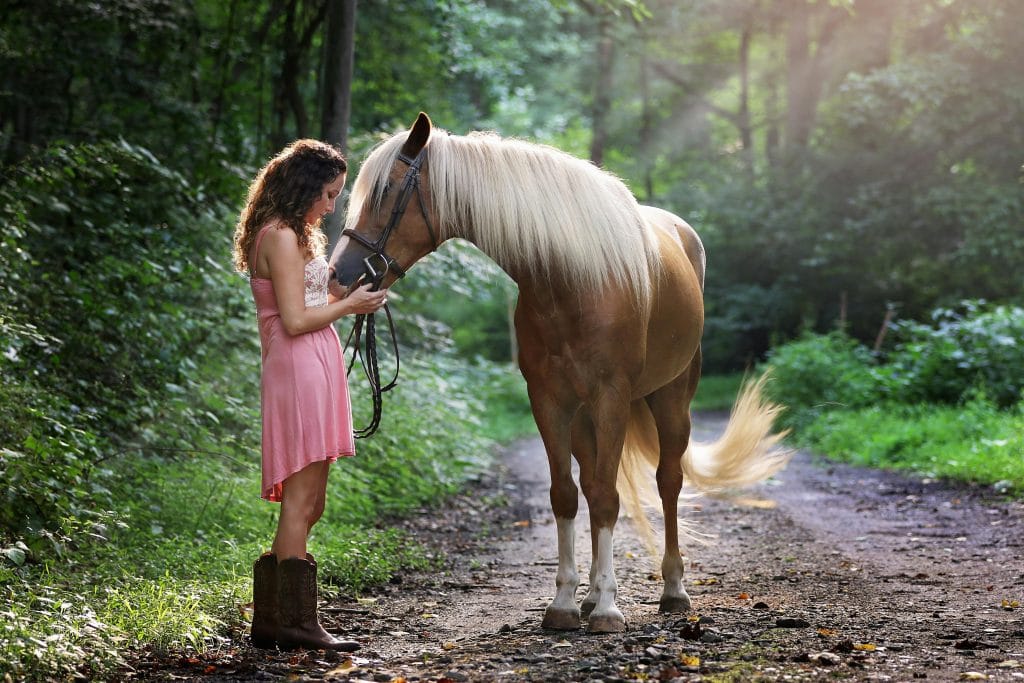
Horses also notice tension instantly. If a teen approaches with tight shoulders and a rushed cue, the horse may drift away; when the teen softens their posture, steadies their breath, and asks more clearly, the horse often steps forward. That cause-and-effect loop becomes a practical lesson — emotional state shapes communication, and communication shapes connection — and because the feedback is immediate and impersonal, teens tend to absorb it rather than feel lectured. For teens used to mixed messages from peers or social media, a partner that responds only to congruence between body, tone, and intention can feel grounding.
What Teens Practice, and Why It Sticks
The value of equine work rests on simple mechanics, not magic. The same handful of skills come up again and again, each one made concrete by the horse's response.
Regulation develops through repeated cycles of pause, breathe, orient, and act. Teens learn to slow down enough to choose a response instead of reacting on impulse, and when they do, the horse often follows — reinforcing the effort in real time. Boundaries become physical before they become social: a teen learns how close is too close, how to hold space with intention rather than force, and that understanding tends to carry into friendships and family conversations. Communication improves as teens experiment with tone, timing, and clarity, since a rushed or mixed cue creates confusion while a balanced one produces movement. And self-efficacy grows through small, earned successes — one steady step, a calm grooming routine, a clean pass through a narrow path — that become tangible evidence new behaviors actually work.
Accountability, importantly, feels safe here. When a cue is inconsistent, the horse simply hesitates; the feedback is immediate but never shaming, which lets a teen notice and adjust without bracing for judgment.
What the Research Suggests
Research on equine-assisted work with young people is growing, and the early picture is cautiously encouraging. A 2023 meta-analysis pooling sixteen controlled studies of roughly a thousand young people found a moderate overall benefit for psychosocial outcomes, with measurable effects on both internalizing concerns such as anxiety and low mood and externalizing behaviors.¹ A broader systematic review of animal-assisted approaches for youth reached similar tentative conclusions while stressing that the evidence base is still limited and uneven in quality.²
The honest summary is that outcomes vary with the program, the facilitator, and the individual teen. Equine therapy is best understood as a promising, complementary option rather than a guaranteed solution, and its value depends heavily on program quality and personal fit.
Program Models Teens May Encounter
Most teen-focused barns offer one or both of the following, each serving a different purpose. Knowing which is which makes it far easier to compare programs.
Equine-assisted psychotherapy (EAP) integrates horses into mental-health sessions led by licensed clinicians. The work is usually done on the ground — grooming, leading, observing herd behavior, or completing structured tasks — and these moments surface relational patterns gently, letting teens try new approaches with support. Equine-assisted learning (EAL), by contrast, is educational rather than clinical: facilitators design experiences that strengthen communication, leadership, problem-solving, and teamwork, which is why many schools, youth agencies, and after-school programs use it to build practical social and executive-functioning skills.
Mounted work shows up in some programs, particularly those offering adaptive riding for recreation and confidence. Even so, groundwork tends to be the safest and most relevant format for teens working through emotional or relational challenges.
What Teen Sessions Usually Look Like
Programs vary, but most sessions follow a predictable rhythm that helps teens settle in and know what to expect.
A session often opens with a brief check-in and a small, doable intention for the day — using a pause before a cue, or staying mindful of spacing. From there the teen moves into work with the horse: brushing in a sequence, leading through a curved path, completing a problem-solving challenge, or joining a group exercise where peers take turns observing and participating. Throughout, the facilitator helps the teen notice how their internal state affects the horse, woven into the activity rather than delivered as a lecture. Sessions usually close by reviewing one success, one challenge, and one strategy to carry into daily life, followed by a steady ending ritual — thanking the horse, returning equipment, a calm moment before leaving. In group settings, teens also learn by watching peers handle similar tasks and practicing communication in a structured but low-pressure context.
Who May Benefit
Many teens take part during seasons of transition or challenge — those experiencing anxiety, low mood, stress after difficult events, school or social conflict, impulsivity, grief, or major family changes. Teens involved in foster care, adoption transitions, or early recovery may also benefit, particularly when a program coordinates with outside clinicians or a care team.
Suitability is always determined case by case, and responsible programs conduct safety screenings so that participation matches a teen's needs and capacity.
Safety, Ethics, and Horse Welfare
Quality programs maintain clear boundaries and a stable environment. Facilitators or clinicians should be able to explain their qualifications, set expectations for behavior around horses, and describe how they support teens emotionally when something gets hard. Teens are never pressured to ride, and groundwork is often the starting point.
Horse welfare is just as central. Horses should be selected for temperament, conditioned for their roles, given rest, and allowed to "say no" through body language, with staff trained to recognize signs of stress and adjust. A well-cared-for horse makes for a safer, more ethical experience — and a program that takes the horse's wellbeing seriously usually takes the teen's seriously too.
Family and School Collaboration
Teens make the most progress when the same cues show up across settings. Programs often share simple phrases — "pause, breathe, ask" or "space, then speak" — that parents, teachers, or counselors can reinforce, so a teen can apply what they practiced with the horse to real conversations at home or school. Occasional family sessions or coordinated check-ins help align goals and connect progress in the barn to progress everywhere else.
A Short Vignette
A sixteen-year-old arrives after a week of conflict and slammed doors. The task is simple: lead a mare through an L-shaped corridor without crowding her. The teen pulls the rope, moves too fast, and the mare stops. The facilitator suggests a reset — step back, breathe out, look ahead, then ask.
The teen tries again, and this time the mare walks with them. "She moved when I stopped yanking," the teen says afterward. That small insight becomes a plan for hard conversations at home: pause, breathe, then ask. Over time, that one sequence can become a stabilizing anchor in moments of stress.
When Equine Work Isn't the Right Fit
Some situations call for different care first. A teen in acute crisis, experiencing psychosis, or struggling with uncontrolled aggression needs a higher level of support before barn activities are safe or useful. Certain medical conditions or allergies may also limit mounted work, though many programs offer meaningful groundwork alternatives. Responsible barns are transparent about these limits and provide referrals when needed.
Equine programs are not crisis care. If a teen is in immediate distress or thinking about hurting themselves, reach out to a doctor or a crisis line right away — in the U.S. and Canada, the 988 Suicide and Crisis Lifeline can be reached by call or text, any time of day.
Final Thoughts
Equine-assisted programs don't replace therapy or other specialized support. They strengthen it by giving teens a space to practice regulation, communication, boundaries, and resilience with a partner that responds honestly every time.
With skilled leadership and a welfare-forward approach, the lessons learned beside a horse — pause, breathe, ask clearly, respect space, try again — often start to show up in classrooms, kitchens, and conversations that go better than they used to. If it sounds like it might fit a teen you care about, the next step is a conversation with their care team, followed by a close look at the quality and fit of specific programs. You can find a program near you in our directory.
SOURCES
- Lac V, et al. The Effectiveness of Equine-Assisted Mental Health Interventions for Youth: A Meta-Analysis of Controlled Studies. Adolescent Research Review. 2023. link.springer.com
- Hoagwood KE, Acri M, Morrissey M, Peth-Pierce R. Animal-Assisted Therapies for Youth with or at risk for Mental Health Problems: A Systematic Review. Applied Developmental Science. 2017;21(1):1-13. doi.org/10.1080/10888691.2015.1134267
This guide is for general information and isn’t medical or mental-health advice. Talk with a qualified provider about your own situation.