

SUMMARY
Equine-assisted programs offer people with special needs a practical, motivating way to build physical skills, communication, regulation, and confidence. Through structured interaction with horses — whether mounted or on the ground — participants practice meaningful routines that carry into home, school, and community life. This guide explains how equine programs work, why horses are effective partners, what a typical session looks like, and how to choose a safe, well-matched program.
Why Equine Work Supports Diverse Needs
For many individuals with special needs, progress often grows from small, repeatable moments: a steadier sit, a quieter breath, a clearer cue, a smoother sequence of steps. In the barn, these small moments stack into patterns. Horses provide consistent movement and clear, honest feedback, and trained professionals shape activities so that new skills connect naturally to everyday life.
Because horses respond to posture, breathing, and intention rather than words alone, they invite participants to communicate in multiple ways. Their steady pace, predictable routine, and sensitivity to human cues create an environment where people can explore new strategies for balance, interaction, and engagement without pressure.
What “Equine Therapy” Can Mean
“Equine therapy” is a broad phrase used by families, educators, and communities, but programs vary widely in purpose and leadership. The common thread is intentional interaction with horses to support growth and participation.
Hippotherapy
A clinical treatment strategy used by licensed physical, occupational, or speech-language therapists. The horse’s movement becomes a tool within an individualized plan of care.
Adaptive or Therapeutic Riding
Instruction that teaches riding skills while adapting lessons for access, safety, and individual goals.
Equine-Assisted Psychotherapy
Mental health care provided by a licensed clinician who integrates equine interaction to support regulation, insight, and relational skills.
Equine-Assisted Learning
A non-clinical, goal-driven approach focusing on communication, teamwork, problem solving, and leadership through structured activities.
A high-quality program will explain clearly which model it uses, who leads each part of the session, and how goals are chosen and measured.
Why Horses Help: Movement, Rhythm, and Responsive Feedback
Horses offer two kinds of input that are especially helpful across a wide range of abilities.
Movement That Organizes the Body
A walking horse produces a three-dimensional motion that resembles human gait. When a rider is safely supported on a moving horse, the pelvis and trunk naturally respond to each step. Over time, this repeated motion can help improve alignment, balance strategies, and coordinated movement. For individuals who do not ride, grooming, leading, and simple ground exercises still offer rhythmic, predictable sensory experience and opportunities for body awareness.
Feedback That Makes Communication Clear
Horses respond instantly to shifts in posture, tone, tension, and direction. Mixed cues may cause hesitation; a calm, clear ask usually results in cooperation. Because horses respond honestly and without judgment, participants quickly see how their actions shape the outcome — turning vague concepts like “slow down,” “use your voice,” or “give space” into direct, felt experiences.
Who May Benefit From Equine-Assisted Programs
Because equine programs can be adapted widely, they may support children, teens, and adults with:
- Neurodevelopmental differences (autism, Down syndrome, intellectual or learning differences)
- Neuromotor conditions (cerebral palsy, stroke, traumatic brain injury)
- Sensory or attention challenges
- Communication, social, or confidence goals
- A desire for inclusive recreation and community participation
Programs typically screen for medical history, comfort level, and safety factors, and many collaborate with existing healthcare or education teams.
Skill Areas That Often Improve
Gains tend to appear gradually, first in the arena and then in everyday routines.
Physical and Motor Skills
Participants may show steadier posture at a desk, easier transitions between positions, more stable steps on uneven surfaces, or greater overall endurance.
Communication and Cognitive Participation
Many individuals demonstrate clearer requests, better follow-through on multi-step directions, and improved alignment between words, gestures, and intent.
Regulation and Confidence
Barn routines encourage pacing, emotional steadiness, and decision-making. Confidence often grows through small but meaningful successes — leading a horse calmly, completing a sequence independently, or riding a smooth circle with simple cues.
Inclusion and Identity
Equine programs offer a sense of belonging, goal setting, and participation in activities that feel purposeful rather than clinical.
What a Session Typically Looks Like
While each program is unique, most sessions use a steady, predictable structure that reduces uncertainty and supports learning.
Arrival and Preview
Participants review the day’s plan with simple words, visuals, or gestures. Equipment is checked, and the horse is greeted calmly.
Activity
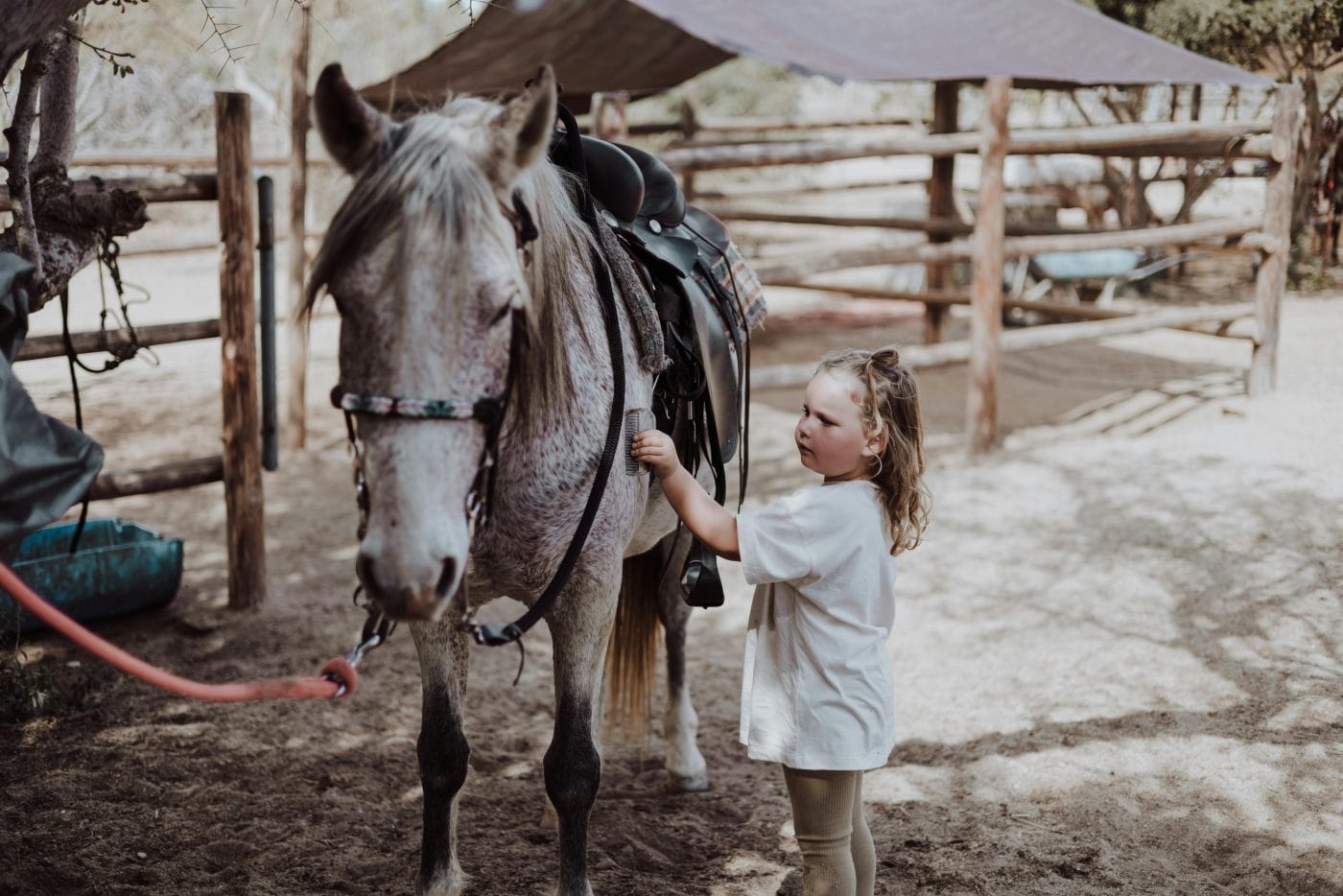
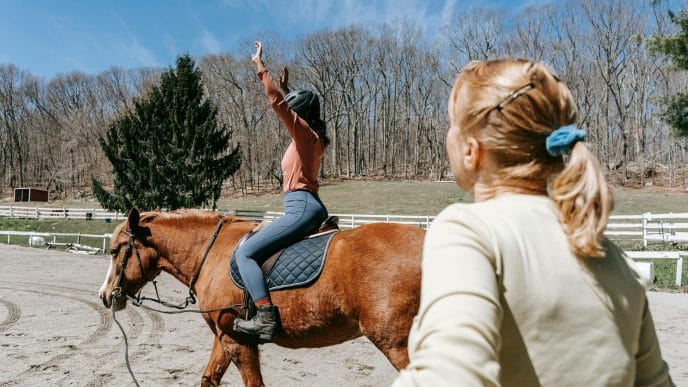
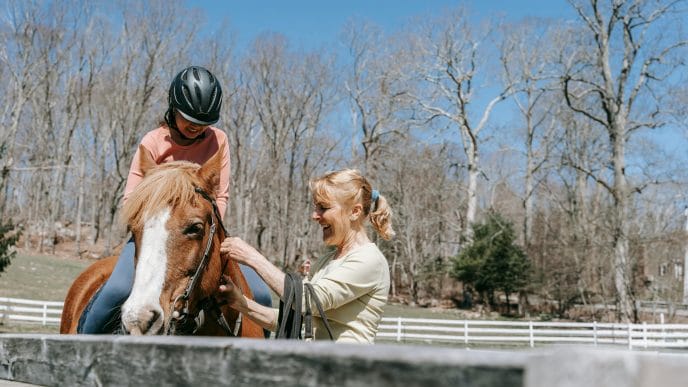
Depending on goals and preferences, the session may include grooming in a sequence, leading through a pattern, mounted activities at a walk, or simple communication tasks with the horse. The pace remains steady and supportive, with cues adapted to the participant’s needs.
Reflection and Goodbye
At the end, the participant and facilitator identify one strategy that worked well and one goal for next time. A consistent goodbye routine helps anchor predictability.
Safety, Access, and Horse Welfare
Safety is central to high-quality equine programs.
Programs should be led by appropriately trained professionals: licensed therapists for clinical services, certified instructors for adaptive riding, and trained facilitators or clinicians for learning or mental health work.
Adaptive equipment — such as fitted helmets, mounting ramps or lifts, surcingles, and visual schedules — supports accessibility without reducing challenge. Programs also set clear “stop rules” when a participant or horse shows signs of stress or fatigue.
Horse welfare is essential. Horses are selected for temperament, trained for the work, rotated for rest, and given opportunities to express discomfort — which staff should recognize and adjust for.
Some medical conditions (such as unstable spine, significant hip instability, uncontrolled seizures, or severe allergies) may limit mounted activities. In these cases, groundwork or carriage driving can offer effective alternatives.
Working With Families, Schools, and Care Teams
Equine sessions are most effective when the same expectations and cues appear in multiple settings. Programs often share one or two phrases — such as “pause, breathe, then ask” or “tall sit before you start” — that can be reinforced at home, in therapy, or at school. Regular communication among teams helps track changes and maintain consistency.
A Short Vignette
A teenager who often rushes under stress is asked to lead a patient gelding through a simple L-shaped pattern. On the first attempt, cues are hurried and inconsistent, and the horse stops. After a short pause and a breath, the teen softens their shoulders and gestures forward with clarity. This time, the horse walks calmly through the path.
The teen leaves with a new phrase: “When I wait, it works.” That simple cue becomes part of morning routines, school tasks, and conversations that require patience.
Conclusion
Equine-assisted programs are not a single method or a one-size-fits-all solution. They are a thoughtful blend of movement, feedback, structure, and community that help people with special needs build practical skills in a motivating environment.
With a well-matched model, qualified leaders, and a horse-first ethic, lessons practiced in the arena often reappear where they matter most — at home, at school, at work, and in moments of everyday confidence.


Where r u located??
Hello,
My name is DJ Calixte. I live in Braintree, MA. I am looking for horse backriding lessons for my 7 year old son who has asperger’s syndrome , near our town. He is verbal and enjoy horseback riding wehen we go to Vermont for our family vacation…
Appreciate the help!!!