SUMMARY
This article explains, in plain educational language, how licensed therapists may use a horse’s movement as part of treatment for cerebral palsy, what sessions typically involve, how progress is observed, and what families can look for when choosing a high-quality, safety-focused program.
Living with cerebral palsy often means working patiently on the small building blocks of movement — finding midline, organizing posture, and coordinating efforts between the trunk, hips, and limbs. Many families look for therapies that help these skills generalize into daily routines. In some settings, licensed clinicians incorporate the movement of a walking horse as one tool within broader physical, occupational, or speech-language therapy. This treatment strategy is known as hippotherapy.
When clinically appropriate, the barn becomes an extension of the therapy room: a place where carefully shaped motion, meaningful tasks, and a responsive partner help participants practice balance, postural control, breath support, and functional communication in a new and motivating environment.
What Hippotherapy Means in This Context
Hippotherapy is not a standalone service. It is a treatment strategy used within the scope of practice of licensed PTs, OTs, and SLPs. The therapist remains responsible for clinical reasoning, safety decisions, and treatment planning. The horse’s movement is simply one of the tools they may select — similar to a therapy ball, balance ladder, metronome, or tactile cueing, but dynamic and adjustable in ways other tools aren’t.
It is distinct from adaptive riding, equine-assisted learning, and psychotherapy. It is also not recreational riding. Sessions are planned, measured, and documented as part of the clinician’s regular plan of care.
Why Horse Movement Can Be Useful
A walking horse generates a steady, three-dimensional motion that resembles the movements of human gait. Sitting astride, with support as needed, the participant’s pelvis and trunk respond to each step. This living “treatment surface” can provide:
A steady postural challenge.
The trunk and hips activate repeatedly to stay centered, helping build endurance, midline awareness, and control.
Opportunities for weight shift and symmetry.
As the horse moves through turns, circles, and direction changes, the rider practices organizing both sides of the body.
Sensory input in a meaningful task.
Vestibular, proprioceptive, and tactile cues come packaged inside an activity that feels purposeful rather than repetitive.
Clinicians adjust the experience by choosing a particular horse, varying stride length, modifying speed, riding figures, or layering in functional tasks such as reaching, timing breath with movement, or planning a simple sequence.
How Goals Are Approached in PT, OT, and Speech
Because cerebral palsy presents differently across individuals, treatment goals vary widely. Still, some common themes appear in educational descriptions of hippotherapy-supported goals.
Physical Therapy Approaches
PTs may use horse movement to help a participant practice organizing the trunk, coordinating head and neck control, improving transitions between positions, or developing steadier balance strategies that support walking or standing.
Occupational Therapy Approaches
OTs often pair postural demand with functional tasks: grasp and release, bilateral coordination, reaching across midline, or maintaining alignment during short activity sequences.
Speech-Language Approaches
SLPs might incorporate mounted tasks that encourage pacing, sustained phonation, breath support, prosody, or attention, when those skills are already part of a speech-language therapy plan.
Mounted work is used only when appropriate for the participant’s body, safety profile, and goals. Many sessions include meaningful groundwork before or after mounted activities.
What a Session Typically Looks Like
Although each program has its own flow, many sessions follow a calm, predictable structure that helps participants prepare, participate, and wind down effectively.
Arrival and Goal Review
Families share updates, and the therapist highlights one or two targets for the session — for example, “focus on level sitting during turns” or “practice steady breath for two short phrases.”
Mounting and Setup
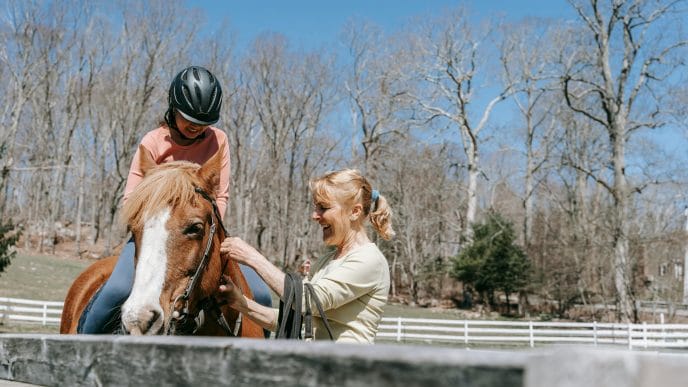
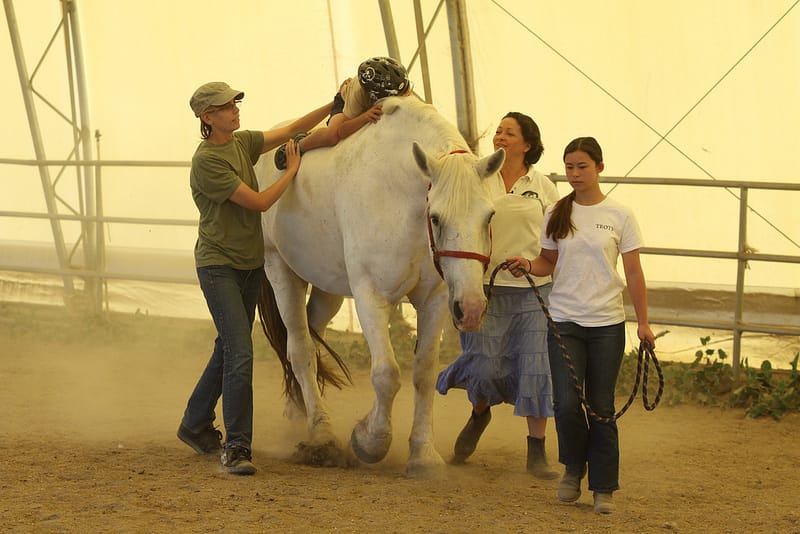
Helmet check, tack inspection, and mounting using a block, ramp, or mechanical lift. Side walkers join only when alignment or safety requires it.
Activity with the Horse
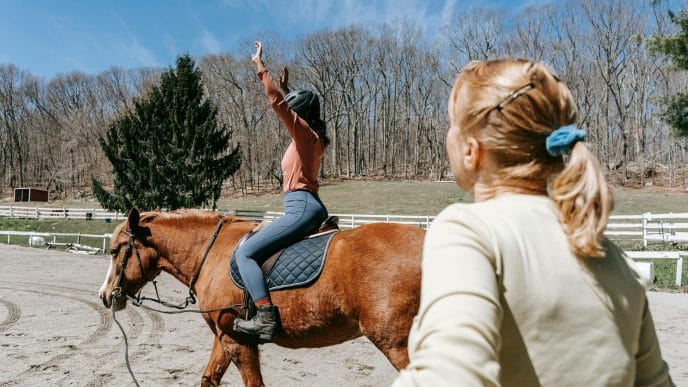
As the horse walks, the therapist shapes tempo, figures, and transitions while layering in tasks such as reaching, tapping across midline, visually tracking a target, or pairing breath with movement. The therapist observes comfort, organization, and the participant’s engagement.
Cool-Down and Dismount
The tempo slows. The participant practices the same alignment off the horse — tall sitting on a bench, gentle stepping, or a short breathing routine.
Home Connection
The session usually ends with one simple cue to use during the week, such as “tall, then step,” “soft ribs,” or “pause and breathe before moving.”
Where Progress Often Shows Up
Real-world changes tend to appear gradually and may include:
- more symmetrical sitting or less collapse to one side
- steadier steps or easier navigation of stairs
- improved tolerance for tabletop tasks
- better ability to coordinate reach, grasp, and release
- increased breath control for speech or sustained vocalization
Clinicians track progress through session notes, periodic re-evaluations, standardized tools when appropriate, and shared observations from school teams and families.
Safety and Screening
Because hippotherapy is used within licensed therapy practice, safety screening is thorough and essential. Programs typically review medical history, discuss precautions, and request clearance from a physician when needed.
Screening often considers:
- orthopedic stability of the spine and hips
- seizure history and control
- bone density and fracture risk
- respiratory or cardiac concerns
- skin integrity and tolerance for positioning
- allergies to horses or hay
If mounted work is not appropriate, many goals can still be addressed through groundwork or clinic-based strategies.
Horse Welfare
The horse is an active partner, not a piece of equipment. High-quality programs select horses for temperament and movement, limit workloads, monitor comfort, and adjust or stop sessions when a horse shows signs of stress. Respectful handling and clear communication protect both horses and participants.
Adaptation and Inclusion
Because cerebral palsy affects each person differently, clinicians tailor sessions thoughtfully. Adaptations may include:
- supportive pads or surcingles for alignment
- visual schedules or brief verbal cues
- frequent breaks or quieter barn times
- positioning aids for trunk or head support
- alternatives such as carriage driving or groundwork
The goal is always the same: set up a safe experience where the participant can work, succeed, and feel respected.
Working With Families and Care Teams
Hippotherapy is most effective when aligned with school therapy, clinical care, and home routines. Families often choose one functional focus for the month — for example, “wider base when stepping,” or “steady breath before speaking.” Using the same cue in all settings helps improvements transfer.
Choosing a Hippotherapy Program
A visit can reveal a great deal. Look for:
- licensed clinicians who can explain the approach clearly
- calm horses and clean, well-fitted tack
- accessible mounting areas
- staff who coach rather than rush
- predictable routines and transparent communication
- thoughtful explanations of how horses are selected and rested
It should feel safe, respectful, and collaborative.
A Short Vignette
A young rider with spastic diplegia tends to collapse through one side while sitting and adopts a very narrow base when walking. During a session, the therapist selects a steady horse and rides slow figure-eight patterns. At each change of bend, they cue the rider to imagine “growing tall to the inside” while lightly contacting the outside thigh.
By the end of the session, the rider steps down the ramp with a noticeably wider, more stable base. The family carries home a simple cue — “Tall, then step.” Over time, it becomes part of getting in and out of the car, walking to class, and navigating the living room.
Conclusion
Hippotherapy does not replace clinic-based therapy. It expands it by providing a dynamic surface that challenges posture, balance, breath coordination, and functional movement in a motivating, real-world setting.
When used by licensed clinicians, with careful screening and a strong horse-welfare ethic, it can reinforce skills that matter most — sitting comfortably, moving with more confidence, communicating with more ease, and navigating everyday life with greater stability.