Program Types
Types of Equine-Assisted Activities Explained
Not every horse program means climbing into a saddle. From adaptive riding to ground-based learning to hands-on horsemanship, here are the main ways to spend time with horses — and how to find your fit.
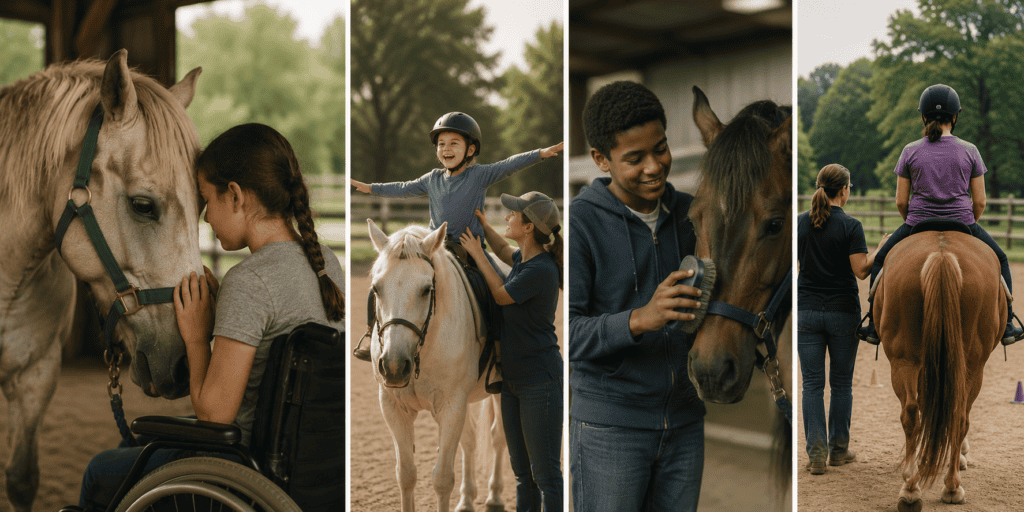
Equine-assisted activities are the hands-on, non-clinical programs where people work with horses to build skills, confidence, and connection — things like adaptive riding lessons, ground-based learning, horsemanship, and group camps. They are recreational, educational, and supportive rather than medical treatment, which is why the field generally prefers the term equine-assisted activities (EAA) over the looser “equestrian therapy.”
This guide walks through the main types so you can see which might fit your interests or goals. It focuses on the activities themselves — what each one is like and who it tends to suit.
For the full set of program categories, including clinical options such as hippotherapy and the professionals licensed to deliver them, see our overview of equine-assisted program types. Any unfamiliar barn terms below are defined in the glossary.
The Main Activities at a Glance
Most non-clinical programs fall into a handful of categories. Many centers offer several, and plenty of people mix them.
| Activity | What it involves | Often suits |
|---|---|---|
| Therapeutic or adaptive riding | Riding lessons adapted to the rider — balance, steering, and communication, with ground prep | People who want to ride with support |
| Equine-assisted learning | Guided, mostly ground-based activities for communication, teamwork, and self-awareness | Those focused on life skills, or who prefer not to ride |
| Unmounted horsemanship | Grooming, horse care, handling, and understanding behavior | People who love horse care and hands-on learning |
| Recreational and inclusive riding | Traditional riding lessons open to mixed needs and experience levels | Those wanting an ongoing riding hobby |
| Group activities and camps | Mounted and ground activities done together, often seasonal | Children and teens who enjoy social, shared experiences |
Therapeutic and Adaptive Riding
Therapeutic riding — often called adaptive riding — is one of the best-known equine-assisted activities. Participants learn riding skills like balance, steering, stopping, and communicating with the horse in a structured, calm setting created by trained instructors and carefully chosen horses. Lessons are paced to the rider: some begin with simple tasks like holding the reins or keeping a steady seat, while others work on patterns, transitions, and finer cues.
What sets it apart from a standard riding school is the emphasis on accessibility and personal growth rather than competition. Adaptive riding leans further into that, individualizing the experience through modified equipment, alternative mounting (ramps, blocks, or lifts), or extra instructor and volunteer support, and often blending mounted time with grooming and groundwork. The two terms overlap heavily; for the finer distinctions, see adaptive riding versus therapeutic riding.
Equine-Assisted Learning
Equine-assisted learning (EAL) builds life skills through structured interaction with horses, usually without riding — grooming, leading, observing behavior, or guided activities that encourage problem-solving, teamwork, and emotional awareness. Because horses respond honestly to posture, tone, and intention, they offer immediate, non-judgmental feedback: approach calmly and clearly and the horse responds in kind; arrive hesitant or distracted and it may wait, prompting the participant to adjust.
EAL is common with children, teens, and adults working on confidence, leadership, or self-awareness. Since it stays on the ground, it is also a good fit for people who prefer not to mount, or who want to build horsemanship before they ride.
Unmounted Horsemanship
Many centers offer horsemanship programs centered entirely on caring for and understanding horses — grooming, learning anatomy and body language, preparing tack, and taking part in daily barn routines. For some people, this is as rewarding as riding, sometimes more so.
Brushing, picking hooves, and gentle, structured care build responsibility, patience, and attention to detail, and learning to read a horse’s mood or lead it safely builds real confidence. Those skills also tend to make riding lessons easier later on.
Recreational and Inclusive Riding
Beyond structured therapeutic or adaptive programs, many centers run recreational riding lessons open to riders of varying needs and experience. These often follow a more traditional riding-school format — equitation, communication with the horse, and skill-building over time — but with flexibility built in.
Beginners start slow with balance and basic cues, while more confident riders explore patterns, trail riding, or group lessons, all in an encouraging, non-competitive setting. For many families, the social side becomes part of the draw: riders socialize around lessons, join barn events, or ride together in small groups.
Group Activities and Camps
Some centers host group programs, seasonal camps, or themed workshops that combine mounted and unmounted activities — riding, games, horsemanship, and teamwork.
Group settings give participants a chance to practice communication and cooperation while sharing the experience, often through obstacle courses, mounted games, grooming stations, or barn chores done together.
Multi-day camps expand that further into full days at the barn with groundwork, creative projects, and outdoor time, blending the feel of a traditional camp with equine-assisted learning. The social side is frequently the highlight, especially for children and teens.
Finding the Right Fit
The best activity depends on what draws you to horses in the first place. If you picture yourself in the saddle, therapeutic, adaptive, or recreational riding is a natural start; if you are more interested in connection, communication, or staying on the ground, equine-assisted learning or horsemanship may suit you better; and if a social, shared experience appeals, a group program or camp is worth a look. Many people end up combining a few.
Whichever you choose, these programs matter not because they make medical claims, but because they offer real opportunities to engage, learn, and grow alongside horses. To explore options, our guide to choosing an equine therapy center can help, and you can browse centers by state in our directory.