SUMMARY
This glossary offers clear, non-clinical explanations of common terms used in equine-assisted activities and riding environments, helping newcomers feel confident and informed at the barn.
New to a barn or horse-centered program? This glossary explains many of the terms you may hear in equine-assisted activities, adaptive riding, and related settings.
These definitions describe how the words are used in practice, who uses them, and why they help create a safe, organized experience for both people and horses. This resource is educational only and not a substitute for professional training or advice.
A
AAT (Animal-Assisted Therapy)
A clinical service delivered by licensed professionals that incorporates animals within their scope of practice. Included here for reference, though not part of non-clinical equine-assisted activities.
Accreditation (Center)
A voluntary review in which a program’s operations, safety practices, and horse care are evaluated against published standards by an external organization.
Adaptive Riding
Individualized riding instruction that supports participation, skill development, and inclusion. Not a clinical service.
AHA (American Hippotherapy Association)
An organization that provides education for licensed healthcare providers who incorporate equine movement in clinical treatment. Included for terminology awareness.
Aids (Riding Aids)
The cues a rider gives a horse — such as leg pressure, seat position, hands, voice, and focus — to communicate direction or pace.
Arousal (Activity Readiness)
A general level of alertness or readiness for learning and participation. Many instructors aim for a comfortable, workable range for both horse and rider.
B
Bilateral Integration
Using both sides of the body together during movement or tasks. Riders may encounter this idea when practicing turns, reaching, or balancing activities.
Boundaries (Space and Contact)
Clear expectations that help keep people and horses safe, comfortable, and respectful of each other’s space.
C
CanTRA (Canadian Therapeutic Riding Association)
A national organization that offers training and certification for adaptive riding instructors and accredits centers in Canada.
Carryover (Generalization)
Using a skill learned in the barn — such as communication or focus — in another setting.
Centerline / Rail
Common arena landmarks. The centerline is the imaginary line down the arena’s length; the rail is the outer track along the fence or wall.
Clinician (Licensed)
A healthcare professional working within their legal scope of practice. Included for clarity when distinguishing clinical services from non-clinical programs.
Co-Regulation
A shared softening or settling of energy between two beings — for example, a steady human presence helping a horse relax.
CTRI (Certified Therapeutic Riding Instructor)
A PATH International credential for instructors who teach adaptive riding.
D
Debrief
A short reflection after an activity to discuss what happened and what can be learned.
Desensitization
Gradual exposure that helps horses become more comfortable with certain stimuli, always with welfare in mind.
Dismount
The act of getting off a horse safely. Some programs also practice assisted or emergency dismount procedures.
E
EAL (Equine-Assisted Learning)
Non-clinical, educational activities that use interactions with horses to support communication, teamwork, and personal growth.
EAP (Equine-Assisted Psychotherapy)
A clinical service led by a licensed mental health provider that includes horse interaction within their therapeutic work. Included for terminology reference only.
EAS (Equine-Assisted Services)
An umbrella term for services involving horses, including adaptive riding, learning programs, horsemanship, and clinical services delivered by licensed professionals.
Ethogram
A catalog of defined horse behaviors used to understand and support equine well-being.
Evidence-Informed
An approach that considers research, professional experience, and participant needs. Often referenced in organizational standards.
F
Figure Eight / Serpentine
Arena patterns used for steering practice, focus, and coordination.
Flight Zone
A horse’s personal space. Understanding this helps people communicate clearly and move safely around horses.
G
Gait (Walk, Trot, Canter)
The horse’s natural movement patterns. Many beginner or adaptive riding lessons focus on the walk for consistency and comfort.
Groundwork
Activities done on the ground — grooming, leading, observing — that support horsemanship and communication.
H
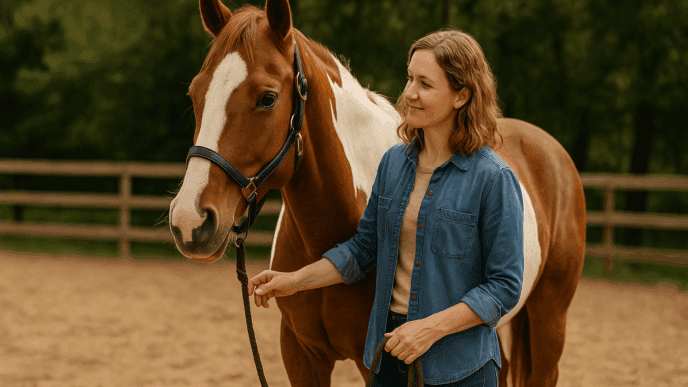
Halters and Leads
Equipment used for guiding and handling horses from the ground.
HAT / ASTM-SEI Helmet
Safety-certified equestrian helmets commonly required during mounted activities.
HCB (Hippotherapy Certification Board)
An organization that certifies licensed professionals who use equine movement in clinical practice. Included for terminology accuracy.
Herd Dynamics
The way horses interact with each other based on spacing, roles, and relationships.
HETI (Horses in Education and Therapy International)
A global association supporting education and dialogue related to equine-assisted services.
Hippotherapy
A clinical treatment strategy used by licensed therapists. Included here for reference and differentiation from non-clinical programs.
Horse Welfare
The physical and emotional well-being of the horse — rest, appropriate workload, clear communication, and the ability to express discomfort.
I
Informed Consent
Clear agreement to participate after understanding expectations and program details.
Instructor (Adaptive Riding)
A professional trained to teach riding in a supportive, adaptive format, distinct from clinical providers.
L
Lead Rope / Leading
Guiding the horse while walking beside or ahead of it.
Lunge Line / Lungeing
Working a horse in a controlled circle. Often used for training and warm-up, practiced cautiously around new riders.
M
Midline
The center axis of the body, referenced in riding for balance and posture.
Mounting Block, Ramp, or Lift
Equipment and methods used to help riders mount a horse safely and comfortably.
N
Neuromotor Sequencing
A term sometimes used in movement education to describe coordinated muscle activation. Included here for definition only.
O
Outcome Measure
Any indicator used to observe progress in a program, such as smoother steering or increased independence.
P
PATH International
An association that publishes standards and certifies adaptive riding instructors and centers.
Plan of Service / Program Plan
A document outlining goals, session structure, and check-in points for non-clinical programs.
POCUS (Plain-Observation Check-In)
A quick scan of posture, breathing, or readiness before starting an activity.
Precaution
A situation that may require adjustments for comfort or safety.
Pressure and Release
A core communication principle in horsemanship — apply a cue, then soften when the horse responds.
Proprioception
Awareness of body position. Riders often develop this naturally while sitting on a moving horse.
R
Regulation
Settling into a steady, workable state of attention. Often supported through pace, rhythm, and clear routines.
Reins
Straps used by the rider to communicate with the horse’s head and neck.
Risk Management
Center-wide procedures that promote safety, such as equipment checks and clear emergency plans.
S
Scope of Role / Scope of Practice
The activities a professional or instructor is qualified to perform, based on training.
Screening (Intake)
A program’s process for understanding a new participant’s goals and comfort level.
Self-Efficacy
Confidence in one’s ability to participate successfully.
Side Walker
A trained helper who walks beside a mounted rider for support and steadiness.
Stop Rule
A predefined condition that pauses or ends an activity if the horse or participant appears uncomfortable.
Surcingle
A wide strap with handles used in some mounted activities in place of a saddle.
T
Tack
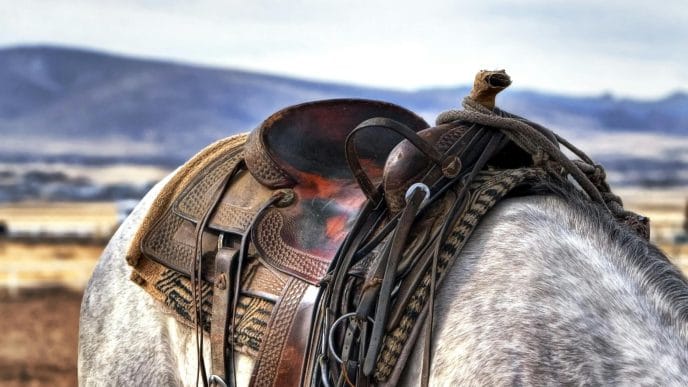
All the equipment used for riding or groundwork.
Therapeutic Driving
An adapted form of carriage driving focused on participation and skill-building. Non-mounted.
Thermal or Tactile Input
Sensations associated with grooming or horse contact.
Transitions
Changes in speed or movement direction, such as walk to halt or halt to walk.
V
Vaulting
Choreographed movement or poses performed on a moving horse, adapted as needed in some programs.
Vestibular Input
Balance-related sensations. Riders experience gentle vestibular input while sitting on a walking horse.
W
Weight Shift
Adjusting weight in the saddle or while standing, important for communication and balance.
Welfare Indicators
Observable signs from a horse that may show stress or comfort level.
Y
Yield
A groundwork movement where the horse steps away from light, clear pressure.
Quick Program Map (Non-Clinical Overview)
- Adaptive Riding: Taught by certified riding instructors
- Equine-Assisted Learning: Facilitated educational and personal development activities
- Horsemanship Programs: Groundwork and horse-care learning experiences
- Recreational Riding: Skill-based riding lessons focused on enjoyment and participation