SUMMARY
This guide explains the major types of equine-assisted programs — what each term generally means, who leads the activities, and how these categories relate to one another in the broader equine-assisted field.
Equine-assisted programs use horses in a wide range of activities, from riding instruction to experiential learning. Many terms sound similar, but each describes a different kind of program with its own purpose and professional structure.
This article offers a clear, plain-language overview of commonly used terms so readers can understand how the field is organized.
Why Equine-Assisted Terms Get Confusing
Because equine-assisted work spans education, recreation, horsemanship, and licensed clinical services, terminology can overlap. People often use “equine-assisted therapy” as a broad label, even though many programs are non-clinical, educational, or recreational in nature.
Understanding the distinctions helps clarify the role of the horse, the focus of the activity, and the kind of professional who typically leads each program.
Equine-Assisted Services (EAS) — The Broad Umbrella
“Equine-Assisted Services” is a general phrase that refers to the full spectrum of programs involving horses in structured ways. This includes both clinical services (provided by licensed professionals) and non-clinical programs such as adaptive riding or equine-assisted learning.
It is a helpful umbrella term, especially when describing the field as a whole.
Hippotherapy
Hippotherapy refers to the use of equine movement by licensed healthcare professionals within their own discipline. The term describes how therapists integrate the horse’s movement into their existing professional scope.
Hippotherapy is not an independent service; it is a strategy used by physical therapists, occupational therapists, or speech-language pathologists. The term is often included in discussions about equine-assisted services because it involves structured handling of horses in a clinical context.
Adaptive or Therapeutic Riding
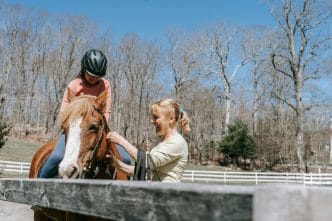
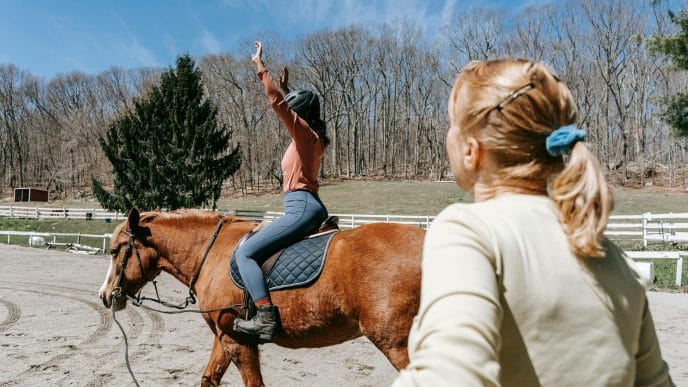
Adaptive riding (sometimes called therapeutic riding) focuses on teaching horseback riding and horsemanship skills. Lessons are adapted to meet a wide range of rider needs, with an emphasis on participation, learning, and enjoyment.
These lessons are led by trained riding instructors, often certified through PATH International, CanTRA, or similar organizations. The core activity is instruction, not healthcare, and programs vary widely in setting and lesson structure.
Equine-Assisted Learning (EAL)
Equine-Assisted Learning uses horse-centered activities to support skill-building in areas such as communication, teamwork, problem solving, and personal awareness. Programs are generally ground-based and experiential.
Facilitators come from a variety of backgrounds — often education, coaching, or leadership training — and use structured exercises to help groups or individuals explore learning themes in a hands-on environment.
Equine-Facilitated Psychotherapy (EFP)
Equine-Facilitated Psychotherapy involves licensed mental health professionals who integrate horses into psychotherapy. Sessions may be mounted or unmounted depending on the model and setting.
This approach remains within the clinician’s existing mental health scope of practice. An equine specialist may assist to support horse-related considerations during sessions.
How These Terms Relate
Each category reflects different roles, training paths, and program structures:
- Hippotherapy: Integrated clinical strategy used by healthcare professionals.
- Adaptive Riding: Riding instruction with adaptations, led by certified instructors.
- EAL: Experiential learning with horses, typically ground-based and educational.
- EFP: Psychotherapy with horses, led by licensed mental health clinicians.
- EAS/EAT (informal use): Broad umbrella terms used to describe the landscape.
Rather than being competing approaches, they occupy different places in the equine-assisted world and often operate side by side within the same facility.
Common Misunderstandings
A few terms are frequently mixed up:
- “Equine-assisted therapy” is often used casually, but specific terminology is more accurate.
- Adaptive riding is instructional, not the same as clinical treatment.
- Many equine-assisted learning programs take place entirely on the ground.
- Not every equine program includes riding.
- Different program types require different professional backgrounds.
Understanding these distinctions helps clarify what each program does without interpreting or predicting outcomes for any individual.
Conclusion
Equine-assisted work spans several professional areas, and each type of program has its own role within the broader field. Whether the focus is instruction, learning, relational work, or clinical integration, clear terminology helps organizations, participants, and families understand how programs differ and how they fit together as part of the larger equine-assisted landscape.